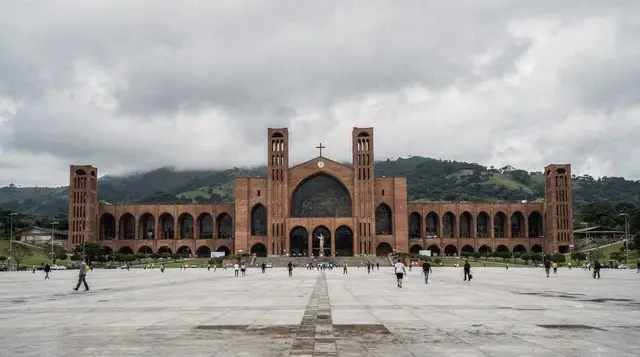
Aparecida is home to the Basílica de Nossa Senhora Aparecida, the sanctuary of Brazil’s patron saint and, by capacity, one of the largest Catholic churches in the world — often cited as second only to St. Peter’s Basilica in Rome. Roughly 170km northeast of São Paulo along the Dutra highway toward Rio de Janeiro, the town exists almost entirely to serve the millions of pilgrims who visit each year, which makes it an unusual destination: part major religious site, part small tourist town built around devotion rather than leisure.
| Where | Rodovia Presidente Dutra (BR-116), Paraíba Valley |
| Cost | Free entry to the basilica; R$0–30 for museum sections |
| Time needed | Half a day for the basilica, a full day with the old town |
| Getting there | Car, bus (frequent departures from Tietê terminal), or a guided tour |
| Best time | Any day; avoid October 12 (feast day) unless you specifically want the pilgrimage crowds |
The basilica itself
The current basilica, consecrated in the 1980s and still not entirely finished in every detail, is a modern structure built to accommodate the scale of Brazilian Catholic pilgrimage — roughly 45,000 people at capacity, with a footprint large enough that first-time visitors are often surprised at how far it is from one end to the other. The image of Nossa Senhora Aparecida at the center — a small, dark terracotta statue found by fishermen in the Paraíba River in 1717, according to the founding legend — draws a striking contrast with the building’s scale: millions come to see an object smaller than a house cat, housed in one of the largest religious buildings on earth.
Inside, the walls and side chapels are covered with ex-votos — photographs, written notes, and object offerings left by pilgrims giving thanks for answered prayers, from medical recoveries to safe returns from difficult journeys. Even for visitors with no religious connection to the site, walking past thousands of these personal offerings gives a sense of what the place means to the people who travel here, some from very far away and on foot.
a guided tour to the Aparecida cathedral from São Paulo covers transport and a knowledgeable guide, which is useful given how much of the site’s meaning is tied to context you won’t get just wandering in.
The old town and the underground museum
Below and around the basilica, a smaller network of shops sells religious souvenirs, candles, and devotional items — some kitsch, some genuinely well-made. The Museu de Aparecida, built partly underground beneath the sanctuary complex, traces the history of the apparition and the basilica’s construction, and is worth the modest entry fee for context on how a fishing-village legend from 1717 grew into a national pilgrimage site.
Crowds and timing
October 12 — the feast day of Nossa Senhora Aparecida and a national holiday in Brazil — draws enormous crowds, with roads into town congested for hours and the basilica itself packed well beyond comfortable browsing. Unless you specifically want to witness that scale of devotion, avoid that date and the days immediately around it. Weekday visits outside major Catholic holidays are calm, sometimes strikingly quiet given the size of the building.
The story behind the statue
The founding legend dates to 1717: three fishermen struggling to catch anything in the Paraíba do Sul River reportedly pulled up a small, headless terracotta statue in their nets, followed shortly after by its missing head, and then — the part every retelling emphasizes — an unusually large catch of fish immediately after. The statue, blackened by river silt or candle smoke depending on which account you read (hence “Aparecida,” roughly “the one who appeared,” referring to her dark coloring), became a local devotional object that grew over the following two centuries into a national symbol, eventually named patron saint of Brazil by Pope Pius XI in 1930. The original 18th-century chapel built to house the statue still stands near the modern basilica — smaller, older, and considerably quieter than the main sanctuary, worth the short walk over if you want a sense of how modest the site’s origins were compared to its current scale.
Where to stay
Aparecida has built an entire hospitality industry around pilgrimage tourism, with hotel options ranging from simple, budget-oriented pilgrim lodgings (R$80–150 per night) to more comfortable mid-range hotels (R$180–350 per night) within walking distance of the basilica. Given the modest half-day time commitment most visitors need, an overnight stay isn’t necessary unless you’re combining Aparecida with an early-morning departure toward Rio de Janeiro or want to see the basilica lit up in the evening, when it takes on a different, more atmospheric character than during the busier daytime hours.
Getting there
The drive from São Paulo runs via the Dutra highway (BR-116), the same route used to reach Rio de Janeiro, so Aparecida works naturally as a stopover if you’re driving between the two cities rather than only as a round-trip day destination. Figure 2 to 2h45 each way outside rush hour; the Dutra can back up significantly on weekday mornings (07:00–10:00) and Friday evenings as commuter and interstate traffic mix. Frequent buses run from São Paulo’s Tietê terminal directly to Aparecida, making this one of the more accessible interior destinations without a car.
Beyond the basilica: the wider Paraíba Valley
Aparecida sits within the Paraíba Valley (Vale do Paraíba), a corridor between São Paulo and Rio de Janeiro that also holds a scatter of smaller historic towns tied to the same 19th-century coffee wealth found elsewhere in the interior — Guaratinguetá and Lorena among them, both a short drive further along the Dutra highway. Few visitors extend a trip out this far specifically for those towns, but if you’re already driving the corridor toward Rio, it’s worth knowing they exist as an option for travelers with a genuine interest in coffee-era architecture beyond the basilica itself.
Practical notes for pilgrims specifically
If you’re combining the trip with onward travel toward Rio de Janeiro or simply want reliable maps and connectivity along the Dutra highway, an eSIM data plan for Brazil is worth setting up before you leave São Paulo, since signal along stretches of the Paraíba Valley highway can be patchy.
For visitors making the trip as an actual pilgrimage rather than general sightseeing, it’s worth knowing that Masses run frequently throughout the day at the main basilica — often every hour or more often during peak periods — and that the sanctuary complex includes confession facilities, a dedicated area for candle offerings, and staff and volunteers used to assisting visitors with specific devotional needs. The scale of the operation reflects the millions of pilgrims who pass through annually, and the infrastructure is considerably more developed than at a typical parish church.
Shopping for religious souvenirs, honestly
The streets around the basilica are dense with shops selling religious items, and quality varies considerably — mass-produced plastic figurines sit alongside genuinely well-made ceramic and wood devotional pieces, often from the same stretch of shops. If you want something more distinctive than the standard tourist-trap souvenirs, ask shopkeepers about locally made items specifically, since a fair amount of the cheaper stock is imported and generic rather than tied to Aparecida itself.
Combining Aparecida with a longer Paraíba Valley stop
If you have more time than a simple half-day basilica visit requires, Aparecida can anchor a broader look at the Paraíba Valley’s coffee-era history, with Guaratinguetá and Lorena both a short drive further along the Dutra toward Rio, each holding their own smaller-scale versions of the 19th-century architecture found more famously in Itu or Campinas. Few visitors build a trip specifically around this corridor, but for anyone already driving the Dutra between São Paulo and Rio de Janeiro, it’s a reasonable way to break up a long highway stretch with something more substantial than a fuel stop.
Frequently asked questions about visiting Aparecida
Do I need to be religious to visit Aparecida?
No. Many visitors come purely for the scale, architecture, and atmosphere, and the site is open to everyone regardless of faith. That said, showing basic respect — quiet voices, appropriate dress — is expected inside the basilica.
How big is the basilica really?
It holds roughly 45,000 people at capacity, making it one of the largest church buildings in the world by that measure, with a footprint far larger than most first-time visitors expect.
Is October 12 a good time to visit?
Only if you specifically want to experience Brazil’s largest pilgrimage day — expect severe road congestion and crowded interiors. Most visitors get a better experience on a quieter day.
Can I visit Aparecida on the way to Rio de Janeiro?
Yes — it sits directly on the Dutra highway between São Paulo and Rio, making it a natural stopover for anyone driving or bussing between the two cities.
How long should I spend there?
Half a day covers the basilica and a walk through the old town; a full day allows time for the museum and a slower pace without feeling rushed.
Is there anywhere to eat nearby?
Yes, the streets around the basilica have simple restaurants and lanchonetes serving Brazilian standards, generally R$25–50 per person — nothing fine dining, but sufficient for a stop.
Is Aparecida safe?
Yes, it’s a well-visited pilgrimage town with a strong tourism and security infrastructure built around the basilica; standard travel caution applies as anywhere.
What is the story behind the statue itself?
According to tradition, three fishermen recovered a small headless terracotta statue from the Paraíba do Sul River in 1717, followed by an unusually large catch of fish, and the object became the center of a devotion that grew over two centuries into Brazil’s national Catholic symbol.
Is there a dress code for visiting the basilica?
Shoulders and knees should be covered, as is standard at major Catholic sanctuaries. There’s no strict enforcement for casual visitors, but it’s respectful given how many people are there for genuine pilgrimage reasons.
Can I visit the original 18th-century chapel too?
Yes, the smaller original chapel built to house the statue still stands near the modern basilica and is a quieter, more historic counterpoint to the massive modern structure — worth the short walk over.
Fitting Aparecida into a longer trip
Aparecida works well as a single-day addition to a five-day São Paulo itinerary, or as a planned stopover if your trip includes a leg toward Rio de Janeiro — see the São Paulo to Rio guide for how the Dutra route and timing work. For other interior day trips to compare it against, check the day trips from São Paulo guide and the day trips compared guide. If you’re traveling without a car, the long-distance buses from São Paulo guide covers the Tietê terminal departures that serve Aparecida directly.