Which day trip from São Paulo to choose
What's the best day trip from São Paulo?
It depends on what you want. Embu das Artes for the easiest half-day handicraft market trip. Santos for beach plus real history. São Roque for wine tasting close to the city. Campos do Jordão for mountain scenery, best as an overnight rather than a rushed day. Aparecida for the country's largest religious sanctuary. Paranapiacaba for atmospheric fog and railway history. Holambra for flowers and photography, if you have a full day to spare on the drive.
São Paulo’s position — inland, at the meeting point of coast, mountains and agricultural interior — makes it one of the better-positioned major cities in South America for genuinely varied day trips, and that variety is exactly what makes choosing one harder than it should be, since almost none of these destinations resemble each other closely enough to substitute for one another. Beach, wine country, alpine-style mountains, colonial handicraft towns and one of the world’s largest religious sanctuaries are all within a few hours’ drive, each delivering a completely different day. This guide compares the main options directly against what you’re actually looking for, rather than ranking them in an arbitrary order.
| Where | The regions surrounding São Paulo: coast, mountains, and interior |
| Cost | R$30–90 (~US$6–17) for tastings and entries; transport varies by distance and method |
| Time needed | Half a day (Embu) to a genuine overnight (Campos do Jordão, Ilhabela) |
| Getting there | Car, organised tour, or bus depending on distance and destination |
| Best time | April–June generally; some destinations have specific peak seasons noted below |
Embu das Artes: the easiest half-day trip
At just 28km and 40 minutes to 1.5 hours out, Embu das Artes is the lowest-effort option on this list — a colonial handicraft town whose weekend market (Saturday and Sunday, roughly 9am-6pm) is a genuine institution rather than a manufactured tourist stop. A guided handicraft tour of Embu das Artes covers the market and colonial architecture efficiently. This is the right pick when you want a real day trip without committing a full day to travel, or as an add-on to a city-focused itinerary that has half a day spare rather than a fully open one. See the Embu das Artes day trip guide.
São Roque: wine tasting close to the city
About 60km out via Rodovia Raposo Tavares, São Roque’s wine route delivers real adegas (wineries) and cachaça tastings within an hour to 1h45 outside rush hour — genuinely the most accessible wine-country day trip near São Paulo. A São Roque wine route tasting tour covers several producers in a single outing, with tastings running R$30–90 (~US$6–17) per person per adega. Peak season is the Festa da Uva, mid-February to early April, when the harvest and festival atmosphere add extra energy but also extra crowds, so a quieter, less rushed visit outside those weeks suits anyone who prefers a slower pace at each stop. This is the pick for couples, small groups and anyone who wants a relaxed, food-and-drink-focused day without a long drive eating into the actual tasting time.
Santos: beach and history in one trip
Already covered in depth in the beach towns compared guide, Santos deserves a mention here too as a genuine day-trip contender beyond pure beach time — the Museu Pelé, the working port and the world’s largest beachfront garden give it more substance than a typical beach day. A combined Santos, São Vicente and Guarujá day trip is the efficient way to see the most of this stretch of coast in a single outing.
Campos do Jordão: worth an overnight, not just a day
At 170km and 2.5-4 hours each way, Campos do Jordão is genuinely stretching the definition of “day trip” — doable, but the drive alone eats a significant chunk of the day, leaving limited time to actually enjoy Brazil’s highest city (1,628m elevation) and its chalets-and-fondue mountain-town identity. A guided day tour to Campos do Jordão handles the logistics, but this is honestly the one destination on this list where an overnight, even just one night, makes a meaningfully better trip than the rushed day-trip version. See the Campos do Jordão day trip guide for the full breakdown.
Aparecida: scale and significance, faith or not
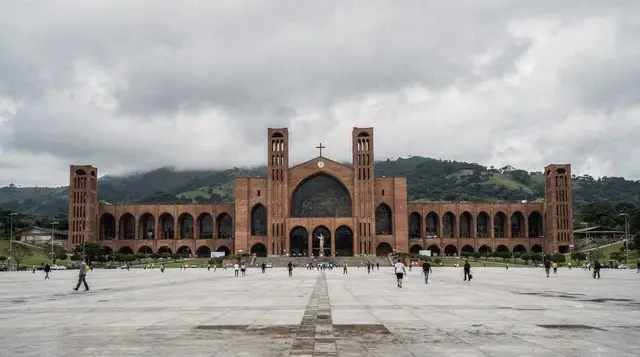
At 170km via the Rodovia Presidente Dutra, Aparecida is home to one of the largest Catholic sanctuaries in the world by capacity — around 45,000 people — and is worth visiting for its sheer architectural scale even for travellers with no religious motivation. Expect significant crowds around October 12, the feast day of Nossa Senhora Aparecida, Brazil’s patron saint; other times of year are considerably calmer. It also works as a natural stop for anyone driving between São Paulo and Rio via the Dutra highway, rather than requiring a dedicated round trip solely for the sanctuary itself.
Paranapiacaba: atmosphere and railway history
At just 55km and 1h15-1h45 out, Paranapiacaba is an underrated, easy half-day trip: a preserved British-built railway village in the Serra do Mar, known for its funicular incline and near-constant fog, thickest and most atmospheric from June to August. It’s a strong pick for photographers and anyone who wants a genuinely different, moody visual experience from the sunny wine-country or handicraft-market alternatives, and it works well paired with Embu das Artes or São Roque if your schedule allows two shorter stops in one day.
Holambra: flowers, but only with a full day to spare
Holambra, 140-150km out via Anhanguera and Bandeirantes highways, is the furthest of the shorter-distance options and needs a genuine full day given the 2h to 2h45 drive each way. The payoff is real — a Dutch-founded flower town with windmills and, during September’s Expoflora festival, a tulip bloom that looks genuinely out of place in Brazil. Outside the festival window, it’s a pleasant but noticeably quieter stop, so timing matters more here than for most of the other options on this list.
Brotas: adventure and rafting for a different kind of day
For visitors wanting something more active than a market, winery or viewpoint, Brotas offers rafting and a genuine adventure-sports scene, a considerably longer drive than the other interior options on this list but a completely different category of day trip — adrenaline rather than sightseeing. It’s a strong pick specifically for travellers who’ve already covered São Paulo’s core sights and want a physically active break from museums and walking tours, though it demands a full day given the distance and isn’t a good fit to combine with anything else on the same outing, and it works considerably better as an overnight for anyone wanting more than a single rafting run. See the we compared five day trips from São Paulo piece for a first-hand account of how a rafting day compares to the calmer alternatives.
Coffee farm tours: a different angle on Brazil’s identity
Brazil’s global identity is deeply tied to coffee, and several farms within reach of São Paulo — some combined with the Holambra or São Roque routes, others standalone — offer tours covering the growing and roasting process alongside a farm lunch. This is a strong pick for coffee enthusiasts and for anyone who wants a day trip built around a specific story rather than a general sightseeing stop, and it pairs naturally with a wine-route day for visitors interested in both of São Paulo state’s major agricultural exports, especially given how close together several coffee-growing areas sit relative to the wine route itself. See the coffee farm tours near São Paulo guide.
Matching the day trip to the season
Timing shifts which of these options makes the most sense on a given visit. São Roque’s Festa da Uva (mid-February to early April) and Holambra’s Expoflora (September) are genuine peak-season events worth timing a trip around specifically, while Paranapiacaba’s fog is thickest and most atmospheric June through August — meaning these three destinations each have a distinct “best window” rather than being equally good year-round. Campos do Jordão, similarly, is at its most characterful in winter (June-August) when the cold-weather chalet identity is fully in effect, and considerably quieter and cheaper the rest of the year for visitors who prioritise avoiding crowds over the peak atmosphere. Embu das Artes, Santos and Aparecida are the most season-neutral of the group, working reasonably well on any weekday outside major national holidays, which makes them the safest default choices when your travel dates don’t line up with any of the other destinations’ specific peak windows.
What each trip actually costs
Costs vary widely across this list. Embu das Artes and Paranapiacaba are the cheapest, with public transport options running well under R$50 (~US$9) each way and no significant entry fees beyond individual purchases. São Roque’s tastings run R$30–90 (~US$6–17) per adega, adding up depending on how many wineries you visit. Aparecida’s basilica is free to enter, making it one of the better-value stops on this list relative to its scale, though transport there costs more given the distance. Campos do Jordão and Holambra carry the highest total cost once transport, any entry fees (Expoflora runs roughly R$40–70, ~US$8–13) and, for Campos do Jordão specifically, potential overnight accommodation are factored in — worth budgeting for accordingly rather than being caught out by the total once transport and food are added up.
Day trips compared directly
| Destination | Distance | Time | Best for | Trade-off |
|---|---|---|---|---|
| Embu das Artes | 28km | 40min-1.5h | Easiest half-day trip | Small, done in a few hours |
| São Roque | 60km | 1-1.75h | Wine tasting | Limited beyond the wine route |
| Paranapiacaba | 55km | 1.25-1.75h | Atmosphere, photography | Small village, quick visit |
| Santos | 72km | 1-1.5h | Beach + history | Beach itself is average |
| Praia Grande/beach | 85km | 1-1.5h | Budget beach day | Least scenic beach option |
| Holambra | 140-150km | 2-2.75h | Flowers (Sept peak) | Quiet outside festival season |
| Aparecida | 170km | 2-2.75h | Scale, architecture | Long drive for a single stop |
| Campos do Jordão | 170km | 2.5-4h | Mountain scenery | Better as an overnight |
Why São Paulo’s day trips are so geographically varied
The variety on this list isn’t an accident of tourism marketing — it comes from real geology and economic history. São Paulo city sits on a plateau roughly 760 metres above sea level, separated from the coast by the Serra do Mar, a steep, forested escarpment that drops sharply toward the beaches at Santos and the litoral norte, which is exactly why the Anchieta and Imigrantes highways feel like a genuine descent rather than a gradual coastal approach. Inland, the interior’s rolling terrain and fertile soil made it prime coffee country from the 19th century onward, and towns like São Roque, Itu and Campinas grew up around that economy, with rail lines built to move coffee to the port at Santos leaving behind the kind of small-town architecture and colonial-era centres that now make places like Embu das Artes and Paranapiacaba worth visiting for reasons that have nothing to do with coffee anymore.
Campos do Jordão and the Serra da Mantiqueira, further northeast, owe their cooler climate to elevation rather than latitude — the range climbs well over 1,500 metres, cool enough that wealthy paulistanos began building mountain retreats there in the early 20th century specifically to escape the city’s summer heat, a pattern that shaped the town’s chalet-heavy architecture long before tourism marketing leaned into a European aesthetic. Understanding this backstory doesn’t change which day trip you should pick, but it explains why the options on this list feel like visiting entirely different countries rather than variations on a theme — they are, geologically and historically, genuinely different landscapes shaped by different centuries of the same state’s economic history.
Public holiday weekends: the trap that catches first-time planners
One mistake shows up more than any other in day-trip planning: booking a Brazilian public holiday long weekend (a “feriadão”) without checking the calendar first. São Paulo state observes national holidays like Tiradentes (April 21), Independence Day (September 7) and Nossa Senhora Aparecida (October 12, which lands directly on Aparecida’s own feast day and multiplies its usual crowds) alongside regional and municipal dates, and when any of these fall near a Friday or Monday, a huge share of the city’s population heads for the coast or the mountains at the same time. The result is entirely predictable and entirely avoidable: a normally 1-to-1.5-hour drive to Santos or Guarujá can stretch past four hours each way, São Roque’s tastings rooms fill to capacity, and Campos do Jordão’s already-limited accommodation sells out weeks ahead at a premium.
The state’s traffic authority (DER) routinely imposes one-direction-only “operação comboio” restrictions on the Anchieta and Imigrantes highways during the worst of these weekends, sometimes closing the uphill or downhill lanes entirely for hours at a stretch. If a feriadão happens to fall during your trip, the safest options on this list are the ones least dependent on the coastal highways — São Roque, Embu das Artes and Paranapiacaba all sit on different, generally less congested routes, and are the more realistic choices when the calendar is working against you rather than for you.
Frequently asked questions about São Paulo day trips
What’s the easiest day trip from São Paulo without a car?
Embu das Artes and Santos are both well served by public transport and organised tours, making them the most accessible without renting a car.
Which day trip is best for wine lovers?
São Roque, without much competition — it’s the closest genuine wine route to the city and the most accessible option for a tasting-focused day.
Is Campos do Jordão really worth it as just a day trip?
It’s doable, but the drive eats a large share of the day; an overnight makes a meaningfully better trip if your schedule allows it.
Which day trip is best for photography?
Paranapiacaba, especially June to August when the fog is thickest, offers the most visually distinctive, atmospheric setting on this list.
Can I combine two day trips in one outing?
Some pair naturally — Santos with Guarujá, or Embu das Artes with a shorter stop nearby — but the longer destinations (Campos do Jordão, Holambra) are best treated as standalone days given the drive time involved.
When is Aparecida busiest?
Around October 12, the feast day of Brazil’s patron saint, when crowds are at their peak. Other times of year are considerably calmer.
Which day trip is best for families with young kids?
Embu das Artes and Santos both work well — manageable distances, engaging but not overwhelming activities, and enough variety to hold kids’ attention without a punishing drive.
Is Brotas worth it if I’m not into adventure sports?
Probably not as a priority — its whole appeal is rafting and adventure activities, so it’s a poor fit for a trip focused on culture, food or relaxed sightseeing.
Which day trip offers the best value for money?
Aparecida — free entry to one of the world’s largest religious sanctuaries — and Embu das Artes, with its free-to-browse market, both deliver a lot for very little direct cost.
Should I book a tour or drive myself?
For the closer, simpler destinations (Embu das Artes, Paranapiacaba), driving or public transport works fine independently. For wine tasting, Campos do Jordão or anywhere you’d rather not navigate unfamiliar roads or coordinate a designated driver, a guided tour removes that friction entirely.
Can I visit any of these destinations on a rainy day?
Aparecida’s basilica and any of the wine-tasting stops at São Roque work well regardless of weather, since most of the experience is indoors; Embu das Artes’ market and Paranapiacaba’s outdoor village are more weather-dependent.
Which day trip pairs best with a visit to São Paulo’s core city sights?
Embu das Artes and São Roque both work well as a half-day add-on either before or after a city-focused itinerary, since neither requires sacrificing a full day that could otherwise go toward Paulista, MASP or Vila Madalena.
Are any of these day trips accessible by public transport alone, with no organised tour?
Embu das Artes, Santos and Praia Grande are all reachable by regular bus services without a tour; the remaining, more distant destinations are technically possible by bus too but considerably more comfortable with a private transfer or organised tour given the connections involved.
Fitting this into your trip
For a broader look at combining several of these into a longer trip, see the five days in São Paulo and around itinerary and seven days in São Paulo and the coast itinerary, both of which build day trips into a wider plan. See the best day trips from São Paulo guide for the fuller list beyond this comparison’s main contenders.
Best day trips from São Paulo on GetYourGuide
Verified deep-linked GetYourGuide tours. Book through these links and we earn a small commission at no cost to you.
These are our own photographs of São Paulo, not the operator's pictures of this tour — open the tour page to see those.