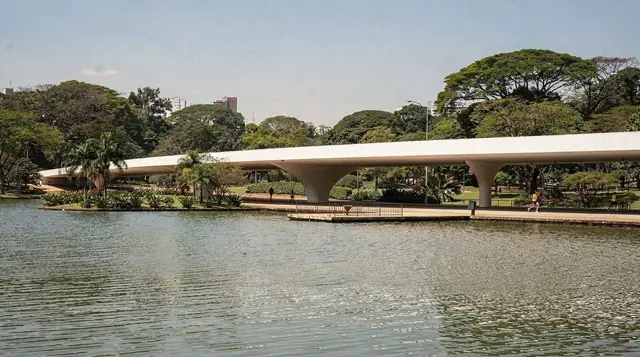
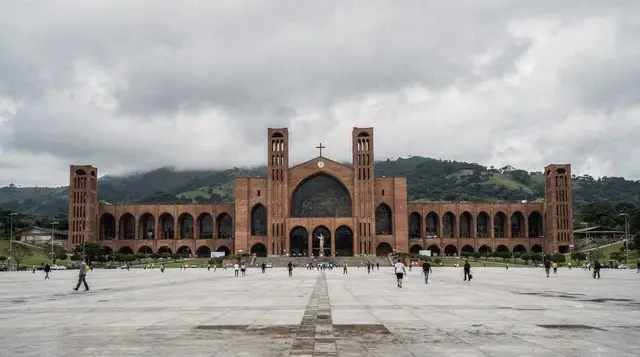
Avenida Paulista on a car-free Sunday
Avenida Paulista is the closest thing São Paulo has to a defining street — a 2.8-kilometre corridor of banks, cultural institutions and high-rises that anchors the city both physically and symbolically. On weekdays it’s exactly what that description suggests: dense traffic, packed sidewalks, a business-district pace that doesn’t invite lingering. Every Sunday, the city closes it entirely to vehicle traffic, and the transformation is one of the more striking things we’ve watched happen to a major street anywhere.
| Where | Avenida Paulista, from Praça Oswaldo Cruz to Praça Marechal Cordeiro de Farias |
| Cost | Free — the closure itself costs nothing, though food and museum entries add up |
| Time needed | 2–4 hours to walk the full length with stops |
| Getting there | Metro Line 2 (Green), stations along the avenue itself |
| Best time | Sundays, roughly 7am to 8pm, weather permitting |
What the closure actually looks like
The full stretch of Paulista shuts to cars from early morning through the evening, and the space fills in almost immediately with cyclists, skaters, joggers, families with strollers, and street vendors setting up along the sidewalks. It’s not a curated event — there’s no central program or ticketing, just an open public space that the city fills organically week after week. The scale of it is what surprises first-time visitors: this isn’t a small pedestrian block, it’s nearly three kilometres of a major avenue, entirely reclaimed for a single day.
MASP as the anchor point
MASP’s distinctive red concrete-and-glass building sits roughly at the midpoint of the avenue, and its ground-floor open space — normally a functional plaza — becomes an informal gathering point on Sundays, sometimes hosting a small market or performers underneath the building’s raised structure. A skip-the-line MASP tour pairs naturally with a Paulista walk, letting you step from the street scene directly into the museum without a queue. See the MASP guide for what’s inside.
Street art and photography along the way
The avenue’s side streets and the area around Museu Aberto (an open-air museum of Brazilian modernist sculpture) offer some of the more photogenic corners of the closure, and the crowd itself — the sheer variety of people using the space — is as much the subject as the architecture. A professional photo tour on Paulista Avenue is a genuinely good use of a Sunday morning if photography is part of why you’re travelling.
Where it connects to Jardins and Bela Vista
Paulista sits between Jardins to the southwest and Bela Vista (including Bixiga) to the northeast, and a Sunday walk naturally spills into either depending on which end you start from. See the Jardins guide and Bixiga guide for what’s worth detouring into if the avenue itself isn’t enough for a full day.
Evening, once the street reopens
The closure winds down in the early evening, and traffic returns to the avenue by nightfall. If the day’s energy carries into the evening, Jardins and nearby Vila Madalena have enough bars within a short walk or metro ride to keep it going — a bar and street art crawl with a local guide is a natural way to extend a Paulista Sunday into the night.
The history behind the closure
The car-free Sunday tradition on Paulista dates back to a pilot program that expanded and became permanent once its popularity was clear — a rare example of a car-centric city walking back vehicle priority on one of its most important streets rather than the more common pattern of adding lanes. It’s worth appreciating in that context: this isn’t a small pedestrian gesture, it’s a full closure of one of Latin America’s most economically important avenues, repeated every single week without exception, which says something about how much public appetite there was for it once people experienced the alternative.
What locals actually do differently from tourists
Watching the crowd closely across several Sundays, the split between locals and visitors becomes fairly clear: locals tend to treat the closure as exercise and routine — running, cycling, walking dogs, meeting friends at a specific bench — while visitors more often treat it as a sightseeing event, moving steadily along the avenue taking photos rather than settling into one spot. Both are legitimate ways to use the space, but if you want the more local experience, pick one stretch of the avenue and stay there for an hour rather than walking its full length in one pass — sit at a café terrace, watch the flow, and let the day’s energy come to you instead.
Rain and the Sunday closure
The closure happens regardless of weather, though a rainy Sunday thins the crowd noticeably and shifts the atmosphere toward a quieter, more local affair rather than the packed, event-like feel of a clear, sunny day. If your visit coincides with one of São Paulo’s summer storms, the closure is still worth a shorter visit — the avenue without cars during a light rain has its own particular calm that a sunny, crowded Sunday doesn’t.
Comparing Paulista on a weekday versus Sunday
| Weekday | Sunday | |
|---|---|---|
| Traffic | Heavy, especially 07h–10h and 17h–20h | None — fully closed to vehicles |
| Who’s on the street | Office workers, commuters | Cyclists, families, street vendors, tourists |
| Pace | Fast, transactional | Slow, social, exploratory |
| Best activity | Museum visit, business meeting | A long walk, market browsing, people-watching |
Beyond Paulista itself: the side streets worth a detour
Some of the more interesting finds on a Paulista Sunday aren’t on the avenue itself but just off it — Rua Augusta, running roughly parallel a few blocks over, has its own independent shops and bars that stay open and busy on Sundays, offering a quieter alternative once the main avenue’s crowds start to feel like too much. A short detour down one of the connecting side streets is a good way to break up a long walk without losing the day’s momentum entirely.
Bringing a camera versus just being present
It’s worth deciding in advance how much of the day you want to spend documenting versus simply being in it — the closure is photogenic enough that it’s easy to spend the whole morning framing shots rather than experiencing the street directly. We’d suggest picking one clear stretch for photography (the area around MASP works well for this) and leaving the camera down for the rest of the walk, which tends to produce a better memory of the day even if it produces fewer photos.
Frequently asked questions about Paulista’s car-free Sunday
Is Avenida Paulista closed to cars every single Sunday?
Yes, consistently, as a standing weekly closure rather than an occasional event.
What time does the closure start and end?
Roughly 7am to 8pm, though it’s worth checking current timing before you plan around it exactly.
Is it worth visiting if I’ve already seen Paulista on a weekday?
Yes — the atmosphere is different enough that it’s close to a separate experience, not a repeat visit.
Do I need a bike, or is walking enough?
Walking is entirely sufficient to enjoy the closure; a bike lets you cover the full 2.8 kilometres faster if that matters to your schedule.
Is MASP open on Sundays?
Yes, and Sundays are typically among its busier days given the closure bringing extra foot traffic past the entrance.
Are there food options along the avenue during the closure?
Yes, street vendors set up along the sidewalks, though a sit-down meal is better found in Jardins or Bixiga just off the avenue.
Is it safe to walk the full length on a Sunday?
Generally yes, given the volume of people present, though normal city awareness still applies, especially near the avenue’s edges after the closure winds down.
Fitting this into your trip
A car-free Paulista Sunday fits naturally into the broader rhythm covered in how to spend a Sunday in São Paulo, and pairs well with the perfect São Paulo weekend itinerary or the three days in São Paulo itinerary if a Sunday falls within your dates.
Trip-planning advice for São Paulo on GetYourGuide
Verified deep-linked GetYourGuide tours. Book through these links and we earn a small commission at no cost to you.
These are our own photographs of São Paulo, not the operator's pictures of this tour — open the tour page to see those.