MASP: visiting the Museu de Arte de São Paulo
Is MASP worth visiting and how much time should I allow?
Yes — it's São Paulo's most important art museum and one of the most architecturally significant buildings in Brazil. Allow 1.5 to 2.5 hours for the permanent collection, longer if you visit on a Sunday when the free antiques market fills the open ground floor beneath the building.
The Museu de Arte de São Paulo sits on Avenida Paulista behind a design so distinctive it’s become shorthand for the city itself: a glass box suspended between four red concrete columns, with nothing but open plaza underneath. That building is architect Lina Bo Bardi’s, completed in 1968, and it isn’t just a striking shell — the way the collection is displayed inside is almost as unusual as the structure holding it up. This guide covers what’s actually inside, what it costs, and how to fit it into an Avenida Paulista visit without wasting half a day in a queue.
| Where | Avenida Paulista 1578, opposite Trianon Park |
| Cost | R$50 full price (~US$10); free on Tuesdays and for under-10s and over-60s |
| Time needed | 1.5–2.5 hours for the permanent collection |
| Getting there | Metro Trianon-MASP (Line 2 Green), exit directly onto the museum plaza |
| Best time | Weekday mornings for the collection; Sunday for the antiques market underneath |
The building is half the reason to come
Lina Bo Bardi, an Italian-born architect who made her career in Brazil, designed MASP as a deliberate civic gesture: by lifting the museum’s mass onto four columns and leaving the ground floor open, she created a free public space in the middle of the city’s most commercial avenue, usable whether or not anyone ever buys a ticket inside. The exposed red columns and the glass box above are structurally load-bearing, not decorative — this was one of the longest free spans in reinforced concrete in the world when it was built. Stand under the building before you go in; it’s one of the few spots on Avenida Paulista where you can get out of the sun and traffic noise for free. The wider avenue context — what else is nearby, when it closes to cars — is in the Avenida Paulista destination guide.
The glass-easel collection: what makes it different
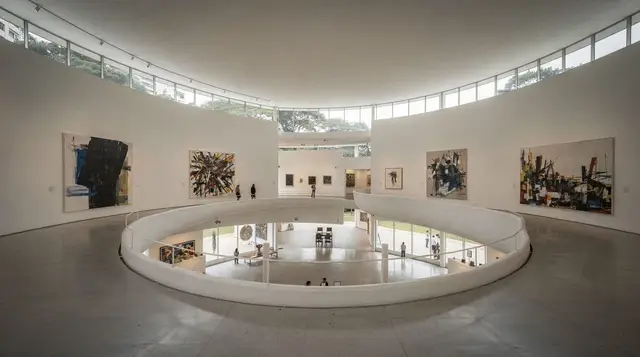
Inside, MASP’s most famous curatorial decision is the glass easel — cristal displays that hold paintings upright on thick glass panes with a concrete base, arranged in open rows across the main gallery floor rather than hung against walls. Bo Bardi designed this system too, in 1968, and it does something most museums don’t: you can see the back of every painting, its frame, its canvas, as well as the front, and because there are no walls breaking up the room, you see the whole collection space at once rather than moving room to room. It fell out of use for a period in the museum’s history and was restored in 2015, and it’s now considered as significant a piece of museum design as the building itself. If you only know one fact about MASP before visiting, this is the one worth knowing — it changes how you look at the art, not just where it hangs.
The permanent collection itself is the most important in Latin America for European art: pieces attributed to Raphael, Titian, Rembrandt, Goya, Renoir, Van Gogh, Degas and Picasso sit alongside a strong holding of Brazilian modernists — Cândido Portinari, Tarsila do Amaral, Di Cavalcanti — and an actively expanding collection of Afro-Brazilian and Indigenous Brazilian art that’s been a deliberate curatorial priority in recent years. Temporary exhibitions occupy the lower and upper floors and rotate every few months, so check what’s showing before you go if a specific show is the draw.
a guided tour of the main collection is worth it here specifically because of the glass-easel layout — a guide can walk you through the collection in a logical order that the open floor plan doesn’t otherwise suggest, and explain what you’re looking at without you needing to squint at wall labels that are, by design, minimal.
A short history worth knowing before you go
MASP was founded in 1947 by the newspaper magnate Assis Chateaubriand and the Italian art critic Pietro Maria Bardi — Lina Bo Bardi’s husband — who together built the collection largely through postwar-era acquisitions in Europe, when a great deal of art was changing hands at prices that wouldn’t exist again. The museum originally occupied a different building on Rua Sete de Abril before moving to the current Avenida Paulista site in 1968, and the move itself was controversial: Bo Bardi’s design was radical for its time, and some of the era’s critics thought a glass box on stilts was a strange way to protect priceless European paintings from a tropical climate. Six decades on, the building is now protected as a national heritage structure in its own right, independent of what hangs inside it. Knowing this context changes how the ground floor plaza reads — it isn’t leftover space, it’s the point.
What’s actually on display, room by room
The permanent collection lives on the second floor, organized loosely by period across the open glass-easel floor rather than in separate numbered rooms — part of what makes a first visit feel disorientating until you understand the format. Look for Portinari’s large-scale figurative work and Tarsila do Amaral’s modernist canvases among the Brazilian holdings, and for the European side, Rembrandt’s self-portraits, several Impressionist-era Degas pieces, and a small but well-regarded group of Renaissance Italian paintings. The museum has also made a sustained effort over the past decade to correct an old imbalance in its collection toward European men, actively acquiring and exhibiting more Afro-Brazilian, Indigenous, and women artists — recent rehangs have deliberately mixed these works into the main glass-easel floor rather than siloing them into a separate temporary show, which is worth knowing if your last visit predates that shift.
The ground floor and basement levels host rotating temporary exhibitions, which change every few months and are sometimes the actual draw for a return visit — MASP has hosted major single-artist retrospectives and thematic shows that get their own separate ticket pricing on top of the standard entry. Check the museum’s current programme before you go if a specific exhibition is why you’re visiting, since it isn’t guaranteed to overlap with the permanent collection you came to expect from photos.
Practical extras: shop, café, and accessibility
There’s a museum shop on the ground floor with exhibition catalogues, art books, and better-than-average souvenirs if you’re after something less generic than the stalls on Rua 25 de Março — see the Brazilian souvenirs guide for how it compares. A café operates in the same open ground-floor space that hosts the Sunday antiques market, a reasonable spot for a coffee break between the museum and the rest of Avenida Paulista rather than a destination in its own right. The building is wheelchair accessible, with lifts connecting the plaza level to the main gallery floor — a rarity worth noting among São Paulo’s older cultural buildings, several of which still have real accessibility gaps. If accessibility is a specific concern for your trip, the accessible São Paulo guide covers the wider picture.
Hours, prices, and free days
MASP is open Tuesday to Sunday, closed Mondays. Standard hours run roughly 10am to 6pm, with Thursday evenings extended later — check the current schedule before you go since museum hours shift periodically. Full-price admission is around R$50 (about US$10), with discounted rates for students and seniors with ID. Entry is free every Tuesday, which is genuinely one of the best free things to do in the city, though it draws bigger crowds than a paid weekday. Children under 10 and adults over 60 enter free year-round.
| Weekday visit | Tuesday (free) | |
|---|---|---|
| Cost | R$50 (~US$10) | Free |
| Crowds | Moderate, manageable | Heavier, especially afternoons |
| Best for | A focused, unhurried visit | Budget travellers, repeat visitors |
| Queue | Usually short | Can build by midday |
Skipping the line
MASP doesn’t usually have Louvre-scale queues, but weekend afternoons and free Tuesdays both build a line at the ticket counter, and it eats into a visit that should take under two hours. a skip-the-line guided entrance solves this directly with pre-purchased timed entry, and if you want the fuller experience without any planning at all, a private skip-the-line tour pairs the fast entry with a dedicated guide for the whole visit. For most travellers with a flexible morning, arriving right at opening on a weekday achieves close to the same result for free.
The Sunday antiques market underneath
Every Sunday, the open ground floor beneath the museum — the same plaza Bo Bardi designed as public space — fills with the Feira de Antiguidades do MASP, a long-running antiques and collectibles market. Stalls sell vinyl records, vintage cameras, old postcards, coins, jewellery and genuine antiques alongside some straightforward tourist bric-a-brac, and it’s worth a browse even if you’re not buying — it’s one of the more atmospheric free things to see on Avenida Paulista, and it puts the building’s ground floor to exactly the civic use it was designed for. If your visit lands on a Sunday, plan to arrive by mid-morning; stalls start closing by mid-afternoon, and the avenue itself is closed to cars every Sunday, which makes the whole area more pleasant to walk. See the Avenida Paulista guide for what else is worth combining with a Sunday visit, and São Paulo’s street markets for how it compares to the city’s other weekend markets.
How MASP fits with the rest of Avenida Paulista
MASP anchors the museum end of Avenida Paulista, but it isn’t the only reason to be on the street. Trianon Park sits directly opposite, a small pocket of Atlantic Forest remnant in the middle of the city and a good spot to sit after the museum. Further along the avenue are Casa das Rosas, the Japan House cultural centre, and — a short walk off Paulista — the Instituto Moreira Salles. If you’re building an art-and-architecture day rather than just a MASP stop, the São Paulo museums guide and São Paulo art galleries guide map out what else is realistically walkable from here, and the São Paulo architecture guide covers Bo Bardi and Niemeyer’s other major buildings if MASP gets you interested in Brazilian modernism more broadly.
Photographers should know that MASP’s columns are one of the most-shot subjects in the city — the São Paulo photography spots guide covers the best angles and timing if that’s part of your visit, and the São Paulo viewpoints guide covers nearby elevated spots if you want a skyline shot to go with your museum day.
Getting there and around
The Trianon-MASP metro station on Line 2 Green puts you directly on the museum’s doorstep — one of the more convenient metro-to-attraction walks in the city, under two minutes from platform to plaza. If you’re coming by car or rideshare, avoid arriving during evening rush hour (5–8pm), when Avenida Paulista itself and the surrounding Jardins and Bela Vista streets slow to a crawl; a trip that should take 15 minutes from nearby neighbourhoods can stretch past 40. On Sundays, remember the avenue is closed to private vehicles for its car-free day, so a rideshare will drop you on a side street rather than directly outside.
Frequently asked questions about visiting MASP
How long does it take to see MASP?
1.5 to 2.5 hours covers the permanent collection at an unhurried pace. Add 30–45 minutes if there’s a temporary exhibition you want to see, and longer still if your visit coincides with the Sunday antiques market underneath.
Is MASP free on any day?
Yes, every Tuesday, plus permanently free entry for children under 10 and adults over 60. Tuesday is the busiest free day, so arrive close to opening if you want a quieter visit.
Do I need to book tickets in advance?
It’s not usually necessary for a standard weekday visit, but booking a skip-the-line entry removes any risk on weekends or free Tuesdays when queues can build.
What is the glass-easel display and why does it matter?
It’s Lina Bo Bardi’s original 1968 display system: paintings mounted upright on freestanding glass panes with a concrete base, arranged across an open floor instead of hung on walls. It lets you see both sides of every painting and the whole collection in one sightline — a genuinely different way of experiencing a museum, and part of why MASP is studied by curators worldwide, not just visited by tourists.
Is the Sunday antiques market worth visiting even if I don’t buy anything?
Yes. It’s free, atmospheric, and puts the museum’s open ground floor to its intended civic use. Go for a browse even if you have no intention of buying — it pairs naturally with Avenida Paulista’s Sunday car-free closure.
How does MASP compare to the Pinacoteca?
They’re different in scale and focus. MASP is stronger on European old masters and has the more famous building and display system; the Pinacoteca, in a converted early-20th-century building near Luz, focuses more heavily on Brazilian art across a longer historical span. Both are worth visiting if you have the time — see the Pinacoteca guide for the comparison in more detail.
Is photography allowed inside MASP?
Generally yes for personal, non-flash photography in the permanent collection, though rules can vary for specific temporary exhibitions — check signage at the entrance to each gallery.
What’s nearby if I want to make a full day of it?
Trianon Park directly opposite for a break, Japan House and Casa das Rosas a short walk down the avenue, and the wider Jardins neighbourhood for lunch. The Avenida Paulista guide lays out a fuller half-day route.
Fitting MASP into a longer trip
MASP fits naturally into day one of almost any São Paulo itinerary, since it’s central, well connected by metro, and pairs easily with the rest of Avenida Paulista. On a one-day itinerary, it’s the anchor for a Paulista-focused afternoon; on a three-day itinerary, combine it with Trianon Park and Japan House in the same half-day and save Centro Histórico for a separate morning. If art and architecture are the reason for your trip specifically, the art and architecture itinerary builds a full multi-day route around MASP, the Pinacoteca, and Niemeyer’s buildings in Ibirapuera Park. For general trip-length planning, see how many days you need in São Paulo.
Museum & art tours on GetYourGuide
Verified deep-linked GetYourGuide tours. Book through these links and we earn a small commission at no cost to you.
These are our own photographs of São Paulo, not the operator's pictures of this tour — open the tour page to see those.