Museu da Língua Portuguesa
What is Museu da Língua Portuguesa, and is it worth visiting if I don't speak Portuguese?
It's an interactive museum inside the historic Estação da Luz train station tracing the Portuguese language's journey from Portugal to Brazil, rebuilt with new digital exhibits after a 2015 fire destroyed much of the original. It's genuinely engaging even without fluent Portuguese — many displays lean on sound, video and interactive projection rather than dense text panels — and it's a short, easy add to a downtown museum morning.
Museu da Língua Portuguesa occupies one of São Paulo’s most striking historic buildings, the Estação da Luz train station, and tells a story most visitors never think to ask about: how Portuguese, a language that started on one small strip of the Iberian Peninsula, became the language of the largest country in South America, spoken with a distinctly Brazilian accent, vocabulary, and rhythm shaped by Indigenous, African, and immigrant influence along the way. The original museum, which opened in 2006, was destroyed by a fire in 2015 that also damaged part of the historic station building; it reopened in 2021 with new interactive exhibits and stronger fire safety measures built into the redesign. This guide covers what’s inside now, how it holds up for non-Portuguese speakers, and why it pairs so naturally with the Pinacoteca do Estado a short walk across the square.
| Where | Estação da Luz, Praça da Luz, Luz |
| Cost | Low-cost or free, depending on current pricing — check before you go |
| Time needed | 1–1.5 hours |
| Getting there | Metro/CPTM Luz station, directly inside the same building |
| Best time | Weekday mornings, combined with the Pinacoteca nearby |
The building itself: a working train station and a museum in one
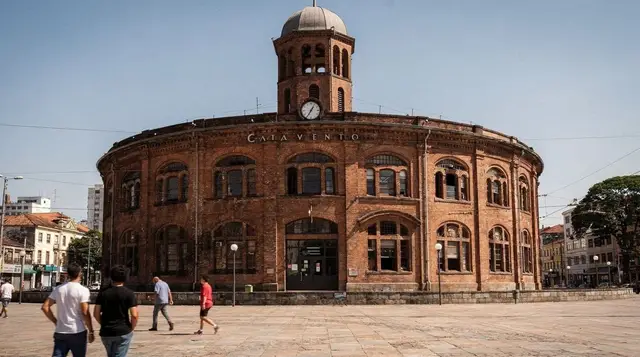
Estação da Luz, completed in 1901, was built with materials shipped from England and remains one of São Paulo’s most significant surviving pieces of 19th-century architecture — an ornate clock tower, iron-and-glass train shed, and a facade that looks more European than anything else downtown. It’s still a working CPTM train station today, which means the museum occupies part of an active piece of transit infrastructure rather than a converted, retired building — an unusual arrangement that adds a layer of everyday life to what could otherwise feel like a purely historical stop.
What’s actually inside after the rebuild
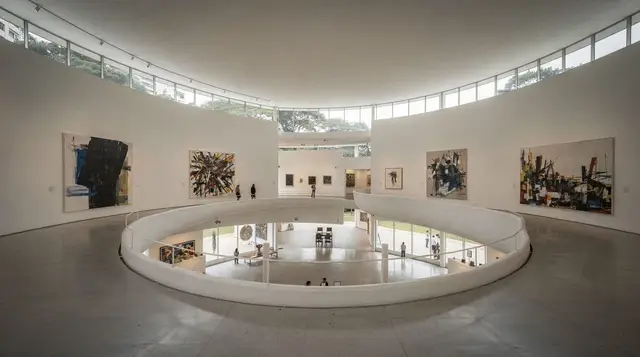
The 2021 reopening leaned into interactive, sound-and-video-based exhibits rather than recreating the original 2006 layout exactly — a deliberate choice partly driven by the need to reduce the kind of flammable materials that contributed to the 2015 fire. Expect large-scale projections tracing the language’s spread from Portugal through colonial Brazil, interactive stations where you can hear regional Brazilian accents and dialects side by side, and sections dedicated to Brazilian literature and its major writers. The format leans hard on visual and audio storytelling, which is part of why it works reasonably well even for visitors without fluent Portuguese — you’re often watching and listening rather than reading dense wall text.
Why this works well for non-Portuguese speakers
A language museum sounds like an obvious skip if you don’t speak the language in question, but the format here works against that assumption. Much of the content is about the sound, rhythm, and regional variation of spoken Brazilian Portuguese — genuinely interesting on a purely sensory level even if you don’t understand every word — and the historical sections on colonisation, Indigenous language influence, and the African languages that shaped Brazilian Portuguese’s vocabulary are told largely through visuals and timelines rather than text-heavy panels. If you’ve been trying to pick up a few Portuguese phrases for travel, this museum gives useful context for why Brazilian Portuguese sounds so different from European Portuguese.
How Brazilian Portuguese diverged from European Portuguese
One of the museum’s more genuinely interesting threads for any visitor, Portuguese speaker or not, is how thoroughly Brazilian Portuguese has diverged from the European version over five centuries of separate development. Indigenous Tupi-Guarani languages contributed a huge number of everyday words — for local flora, fauna, and place names, including “São Paulo” itself sitting in a landscape whose original names predate Portuguese colonisation — while the languages brought by enslaved Africans, along with later waves of Italian, Japanese, and other immigrant communities covered elsewhere on this site, shaped pronunciation, vocabulary, and even grammar in ways that make Brazilian and European Portuguese sound distinctly different today, sometimes to the point of mutual difficulty in fast, colloquial speech.
The museum traces this evolution with a level of detail that goes well beyond what most visitors would otherwise encounter, and it directly complements the wider story told at how immigration built São Paulo — language, in a very concrete sense, is one of the clearest records of who arrived and when.
A useful stop before you need to actually use the language
Even a short visit here pays off practically for the rest of a Brazil trip. Understanding that Brazilian Portuguese carries this much layered history changes how a traveller hears the language day to day — the sing-song rhythm, the vowel sounds that differ so much from Spanish despite superficial written similarity, the vocabulary borrowed from Tupi-Guarani for things you’ll actually encounter, like “abacaxi” (pineapple) or many place names across the country. If picking up a handful of useful phrases before your trip is on your list, visiting this museum early in your stay — rather than at the end — gives that vocabulary a richer context for the rest of your time in Brazil.
Brazilian literature, and where the museum points you next
A dedicated section of the museum traces the development of Brazilian literature, from colonial-era writing through the modernist literary movement that ran alongside the visual-art modernism represented at the Pinacoteca — writers like Mário de Andrade and Oswald de Andrade, whose 1920s “Anthropophagic Manifesto” argued for a distinctly Brazilian cultural identity that “devoured” and transformed European influence rather than simply imitating it, a framing that still comes up in discussions of Brazilian art, music, and design today. If this period of Brazilian cultural history catches your interest here, it pairs directly with the modernist painting rooms at the Pinacoteca — the same intellectual and artistic movement expressed across two different mediums, a short walk apart from each other.
What to skip if you’re pressed for time
If a full visit doesn’t fit your schedule, prioritise the interactive language-sound stations and the central hall’s large-scale projection over the more text-heavy literature sections toward the back of the museum — the sound and video exhibits deliver the museum’s most distinctive experience in the shortest amount of time, while the literary history sections reward a slower, more dedicated visit that not every itinerary has room for.
Accessibility and visiting with limited mobility
The museum occupies part of a working historic train station, which brings some of the same accessibility considerations as the building’s original 1901 construction — lifts have been added to connect the main exhibition floors, though the overall circulation through a converted heritage building is less uniformly step-free than a purpose-built modern museum would be. Staff at the entrance can point out the most direct accessible route if mobility is a concern, and it’s worth asking on arrival rather than assuming standard signage will cover it. See the accessible São Paulo guide for the wider picture on navigating the city’s older buildings.
Pairing with the Pinacoteca, right across the square
Museu da Língua Portuguesa sits directly on Praça da Luz, a short walk from the Pinacoteca do Estado, which makes the two an obvious pairing for a downtown museum morning — one covers Brazilian art history, the other covers the language itself, and neither needs more than 1.5 to 2 hours, leaving time for both plus lunch before early afternoon.
| Museu da Língua Portuguesa | Pinacoteca do Estado | |
|---|---|---|
| Focus | Portuguese language history | Brazilian art history |
| Format | Interactive, digital, sound-based | Traditional galleries |
| Time needed | 1–1.5 hours | 1.5–2 hours |
| Location | Inside Estação da Luz | Edge of Jardim da Luz, short walk away |
Getting there and the Luz neighbourhood
The museum sits directly inside Luz station, so there’s no separate walk required if you’re arriving by metro or CPTM — you’re essentially inside the building the moment you exit the platform area. As with the nearby Pinacoteca, the immediate area around the station and Praça da Luz is fine during the day; the honest caution applies further northwest toward Cracolândia, not to the station or square themselves. See the São Paulo safety guide for the fuller picture on navigating this part of downtown.
The 2015 fire, in more detail
The fire that closed the original museum broke out in December 2015, during renovation work being carried out while the museum remained partially open to visitors, and it spread quickly through the building’s upper floors, destroying a large share of the original exhibition space along with much of the interactive technology that had made the 2006 museum notable when it first opened.
A firefighter died battling the blaze, and the loss was treated as a genuine cultural tragedy in Brazil at the time, not just a building closure — Estação da Luz itself, as one of the city’s most significant surviving 19th-century structures, was already a protected heritage building, which made the fire’s damage to a historic landmark part of the story alongside the loss of the museum’s content. The rebuild that followed took roughly six years, reopening in 2021, and used the opportunity to substantially upgrade fire safety systems throughout the building — a direct response to how the original fire spread, and part of why the current museum leans on newer display technology rather than simply replacing what was lost with an equivalent of the original setup.
Tupi-Guarani place names across São Paulo: a practical list
One of the more genuinely useful things this museum leaves you with is a sharper ear for how much of São Paulo’s geography still carries Indigenous Tupi-Guarani names, layered underneath the Portuguese city built on top of them. Ipiranga, home to the independence museum, comes from Tupi words roughly meaning “red river,” a reference to the reddish water colour from iron-rich soil. Anhangabaú, the valley running through Centro Histórico, translates roughly to “evil spirit’s water hole.” Tietê, the river that runs through the city and gives its name to the major bus terminal, means roughly “true water” or “good water” in Tupi.
Butantã, home to the snake research institute, is thought to derive from a Tupi term connected to hard or rocky ground. Guarulhos, the city hosting São Paulo’s main international airport, likely comes from a Tupi-Guarani word for a type of bird. Itaquera, home to Corinthians’ stadium, translates roughly to “stone house” or “rocky place.” None of this changes how you’d navigate the city day to day, but it’s a genuinely different way of seeing São Paulo once you notice it — a layer of much older geography that survived colonisation, industrialisation and a century of explosive growth, hiding in plain sight inside street signs and metro station names most visitors read without a second thought.
Why Brazil’s linguistic diversity goes beyond Portuguese
The museum’s story understandably centres on Portuguese, but it’s worth knowing the wider linguistic picture as context: Brazil is home to well over 150 living Indigenous languages today, a fraction of the number spoken before European colonisation but still a genuinely significant linguistic landscape that exists alongside, not replaced by, Brazilian Portuguese.
Most of these languages are spoken by small communities, many in the Amazon region far from São Paulo, and few tourists encounter them directly on a typical Brazil trip — but their influence on Brazilian Portuguese vocabulary, place names and even some grammar patterns is a live thread the museum touches on rather than treating Indigenous language purely as a historical footnote. São Paulo’s immigrant languages add a further layer still: Japanese remains actively spoken within parts of the Liberdade community, and pockets of Italian, German and other immigrant languages persisted for generations in specific neighbourhoods and rural communities across São Paulo state, even as Portuguese remained the dominant public language throughout.
Combining a visit with the wider Luz neighbourhood
Beyond the Pinacoteca, Praça da Luz and the surrounding Jardim da Luz botanical garden give this corner of downtown enough to fill a full morning beyond the museum itself — a rare pocket of greenery within walking distance of Centro Histórico’s denser blocks, with a small lake and mature trees that make a pleasant pause between museum stops. The square itself sees a genuine cross-section of the city on any given weekday — commuters passing through the station, students, and museum visitors overlapping with the neighbourhood’s everyday rhythm rather than existing as a purely tourist-oriented plaza.
Why the museum sits inside a train station at all
It’s worth explaining the somewhat unusual choice to house a language museum inside an active train station rather than a dedicated building, since it’s not an obvious pairing at first glance. Estação da Luz was, by the early 2000s, an underused piece of the city’s built heritage — architecturally significant but no longer central to how most paulistanos moved through the city, since the surrounding Luz district had declined from its early-20th-century prominence. Placing the museum here was partly a deliberate act of urban revitalisation, giving the historic station a cultural function beyond transit and drawing visitors back into a part of downtown that needed the renewed foot traffic. It’s part of a broader pattern in São Paulo of repurposing grand early-20th-century buildings — many built during the coffee-boom decades when the city had money to spend on ambitious architecture — for cultural rather than purely functional use once their original role diminished.
Frequently asked questions about visiting Museu da Língua Portuguesa
Do I need to speak Portuguese to enjoy this museum?
No — much of the content is sound- and video-based, and the historical and linguistic story comes through visually even without understanding every spoken or written detail.
How long should I budget?
1 to 1.5 hours is enough for a thorough visit, making it easy to combine with a longer stop nearby.
Is the museum the same as before the 2015 fire?
No — it was substantially rebuilt with new exhibits, safer materials, and a more digitally interactive format when it reopened in 2021.
Is it easy to combine with the Pinacoteca?
Yes, they’re a short walk apart across Praça da Luz, and together they make a well-paced downtown museum morning.
Is Luz station itself safe to pass through?
Yes, it’s a busy, actively used transit hub during the day. Ordinary city awareness applies, as it would at any major station.
Is there an English audio guide or English signage?
Coverage varies by exhibit and can change, so check current availability on arrival — the strongly visual and audio format of many displays reduces how much this matters compared to a text-heavy museum.
Is the museum good for kids?
Reasonably, especially the interactive sound stations, though younger children may find the historical timeline sections less engaging than Catavento’s hands-on science exhibits.
What happened to the original 2006 exhibits after the fire?
Most were destroyed or damaged beyond repair in the December 2015 fire; the 2021 reopening rebuilt the museum’s content largely from scratch with new interactive technology rather than restoring the original displays.
Fitting Museu da Língua Portuguesa into a longer trip
This is a natural half-morning stop alongside the Pinacoteca and the wider Centro Histórico district on a three-day itinerary. It’s short enough to fit even on a one-day itinerary if your route already passes through Luz on the way downtown, and it adds real context to any part of the trip that involves reading menus, signs, or trying out a few words of Portuguese phrases elsewhere in the city.
Museum & art tours on GetYourGuide
Verified deep-linked GetYourGuide tours. Book through these links and we earn a small commission at no cost to you.
These are our own photographs of São Paulo, not the operator's pictures of this tour — open the tour page to see those.