Accessible São Paulo
Is São Paulo an accessible city for wheelchair users and travellers with limited mobility?
Partly, and unevenly. The metro network is genuinely well equipped with elevators and tactile paving, and modern buildings, malls and museums meet real accessibility standards. The problem is street level: cracked, narrow, badly maintained sidewalks are the norm across most neighbourhoods, and kerb cuts are inconsistent. Plan around private transfers and accessible attractions rather than assuming you can walk freely between them.
São Paulo doesn’t get discussed much in accessible-travel circles, and that’s a genuine gap, because the honest picture is more mixed — and in places more encouraging — than most visitors assume. The metro system is one of the better accessible transit networks in South America. Modern shopping malls, corporate towers and newer museums were built to real accessibility codes. But this is also a city of 12 million people laid out over more than a century, with sidewalks (calçadas) that are the legal responsibility of the individual property owner in front of them rather than the municipality — which is exactly why paving quality changes block by block, sometimes step by step. This guide covers what actually works, what doesn’t, and how to plan a trip around the difference rather than discovering it the hard way on day one.
| Where | Citywide — quality varies sharply by neighbourhood and building age |
| Cost | Private transfers add roughly R$80–250 (~US$15–45) per trip over public transport |
| Time needed | Budget 20–30% more time than a standard itinerary suggests |
| Getting there | Metro is the most reliably accessible option; taxis and ride-apps for door-to-door |
| Best time | April–June — dry pavements matter more here than almost anywhere, since rain turns already uneven sidewalks genuinely hazardous |
The metro and CPTM: the strongest part of the system
São Paulo’s metro (Lines 1–5 plus the newer 15-Silver monorail) and the CPTM commuter rail network are, station by station, the most consistently accessible part of the city. The great majority of stations have working elevators, tactile paving strips leading to platforms, priority boarding areas, and audio announcements. Line 4-Yellow and Line 5-Lilac, both built or heavily renovated in the last two decades, are the most reliably equipped end to end. Older stations on Line 1-Blue and Line 3-Red can have elevators that are undersized, occasionally out of service, or positioned awkwardly relative to the platform — checking the current elevator status on the SPTrans or Metrô São Paulo app before relying on a specific station is worth the two minutes it takes. See the São Paulo metro guide for the full line-by-line breakdown and the Bilhete Único guide for how the transport card works, since staff at ticket booths can also flag which elevators are down that day.
Sidewalks: the honest, unglamorous truth
This is the part accessible-travel guides to São Paulo tend to gloss over, and it shouldn’t be. Because sidewalk maintenance is legally the responsibility of whoever owns the building fronting it, paving quality shifts constantly — smooth tiled stretches outside a bank give way, mid-block, to cracked concrete, exposed tree roots, missing paving stones or a kerb with no ramp at all. Parked cars and motorbikes routinely block what ramps do exist, particularly in commercial areas and around metro exits at rush hour.
Jardins and Avenida Paulista tend to have the best-maintained stretches, in part because commercial property owners there invest more in their frontage; older residential streets in Vila Madalena, Pinheiros and especially Centro Histórico are far more unpredictable. None of this makes independent travel impossible, but it does mean route-planning matters more here than in a city with municipally maintained, uniform paving — and that a short walk on a map can turn into a genuinely awkward one on the ground.
Getting around without relying on long walks
Given the sidewalk reality, the practical answer for most of a São Paulo trip is to lean on transport rather than walking between sights. Uber and 99 (the dominant local ride-app) both offer accessible vehicle options in São Paulo, though availability and wait times for wheelchair-accessible vehicles specifically can run longer than for a standard car — building in extra time is sensible. Regular taxis are a reliable fallback and most drivers will assist with folding wheelchairs into the trunk on request.
For arrival and departure days, and for any day trip out of the city, a private airport transfer removes the accessibility variable entirely — door-to-door, on your schedule, no need to navigate a bus terminal or negotiate a shared shuttle. The same logic applies to day trips: a private transfer to the coast is a far more predictable option than a public bus terminal, where accessibility varies station to station. See the taxis and ride apps guide and the getting around São Paulo guide for the fuller picture of how each option compares on cost and reliability.
Museums and major attractions: generally strong
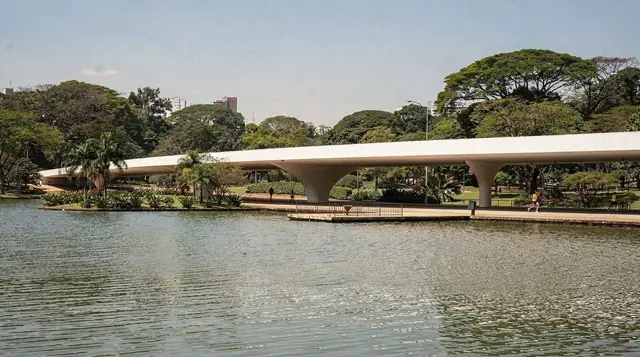
The good news concentrates here. MASP, on Avenida Paulista, is fully accessible with ramps, elevators and accessible restrooms — its famous glass-box design was retrofitted with modern access in mind. The Pinacoteca do Estado, Museu Afro Brasil and the Museu da Língua Portuguesa (rebuilt after a 2015 fire) are all wheelchair accessible, as is Parque Ibirapuera itself, whose main paths are paved, wide and largely flat, making it one of the most genuinely accessible outdoor spaces in the city — see the Ibirapuera Park guide for the specific paved-loop route.
Shopping malls across the city (Iguatemi, Cidade Jardim, JK Iguatemi) meet strong accessibility standards as a matter of course, and often double as useful rest points on a longer day out, with accessible restrooms and lifts between floors. Weaker spots include some older attractions in Centro Histórico, where accessibility was never part of the original 19th- and early 20th-century design and retrofits are partial at best, and Beco do Batman in Vila Madalena, which sits on a genuinely sloped, narrow street that’s difficult for wheelchair users regardless of paving quality. See the MASP guide and best museums in São Paulo guide for more on individual venues.
Restaurants, markets and everyday accessibility
Restaurant accessibility in São Paulo is inconsistent and worth checking ahead rather than assuming. Newer restaurants in Jardins, Itaim Bibi and the shopping-mall food scene tend to have step-free entry and accessible restrooms as standard; older, smaller, family-run places — including some of the best traditional restaurants in Bixiga and Mooca — may have a step at the entrance or a narrow bathroom that a wheelchair genuinely can’t get into. Calling ahead, or checking recent photos on Google Maps, beats guessing. The Mercado Municipal (Mercadão) is step-accessible at its main entrances but gets genuinely crowded at peak hours, which matters more for manoeuvring a wheelchair than the paving itself — a mid-morning weekday visit is far easier than a Saturday lunchtime rush. See the Mercado Municipal guide and where to eat in São Paulo guide for specific recommendations.
Where to stay for the easiest access
Basing yourself in Jardins or along Avenida Paulista does double duty for accessibility: both have the city’s best-maintained sidewalks relative to the rest of São Paulo, sit directly on well-equipped metro stations, and offer the highest concentration of modern hotels built with lifts and accessible rooms as standard. Itaim Bibi and Vila Olímpia, the newer business district, are similarly strong on building-level accessibility, if slightly less central for sightseeing. Avoid Centro Histórico as a base for the same reasons it’s a weaker choice generally — older buildings, rougher pavements, and an area that’s genuinely harder to navigate after dark regardless of mobility. See the where to stay in São Paulo guide for the full neighbourhood breakdown, and always confirm accessible-room specifics (roll-in shower vs. tub, door widths) directly with the hotel — online listings are not always accurate on this.
Airports: what to expect on arrival and departure
All three of São Paulo’s airports — Guarulhos (GRU), Congonhas (CGH) and Viracopos (VCP) — offer wheelchair assistance services that can be requested through your airline in advance, and GRU in particular has invested heavily in accessible infrastructure as Latin America’s busiest international hub. The practical friction point is usually the transfer into the city rather than the airport itself: public bus links from GRU involve stairs and crowded platforms at busy times, which is exactly why a private transfer from Guarulhos is worth the extra cost for anyone with mobility needs. See the Guarulhos GRU airport guide, Congonhas CGH airport guide and São Paulo airport transfers compared guide for the fuller comparison.
Stadiums, events and accessibility
Big-ticket experiences like a football match or a major event add their own layer of planning. Neo Química Arena (Corinthians), Allianz Parque (Palmeiras) and the recently modernised Morumbi (São Paulo FC) were all built or renovated within the last decade or so and include designated wheelchair-accessible seating areas with sightlines that clear the standing crowd in front — a real concern in Brazilian stadiums, where fans stand for most of a match. Accessible seating is limited relative to overall capacity, so booking through the club or a tour operator well ahead of matchday matters more than it would for a general-admission seat.
See the football in São Paulo guide and the individual Corinthians, Palmeiras and São Paulo FC guides for stadium-specific detail. Large seasonal events — Carnival blocos, the car-free Sunday on Paulista, the Réveillon crowds — bring dense crowds that are genuinely harder to navigate regardless of infrastructure quality; if attending during one of these, arriving early and picking a fixed viewing spot beats trying to move through the crowd once it has built up. See the Carnival in São Paulo guide and New Year’s Eve in São Paulo guide for the specifics of each.
Travelling with a companion, and what locals actually do
Brazilian accessibility law (the Lei Brasileira de Inclusão) requires priority service, seating and often a companion discount at ticketed attractions, museums and events — worth mentioning at the ticket counter, since it isn’t always advertised in English or obvious to a foreign visitor. Staff at major attractions and on the metro are, in general, helpful and used to assisting; the gap is almost always physical infrastructure rather than attitude. Brazilians with mobility needs who live in São Paulo tend to concentrate their routines around the same accessible core this guide recommends — metro-linked neighbourhoods, malls, modern buildings — which is itself a reasonable signal for a visitor deciding where to spend time.
Comparing accessibility by area
| Area | Sidewalk quality | Metro access | Verdict |
|---|---|---|---|
| Avenida Paulista / Jardins | Good, well maintained | Excellent, multiple lines | Best base overall |
| Itaim Bibi / Vila Olímpia | Good, modern buildings | Strong, Line 4-Yellow | Strong alternative base |
| Vila Madalena / Pinheiros | Mixed, hilly in places | Good | Fine for visiting, harder as a base |
| Centro Histórico | Poor to mixed | Good but older stations | Visit by day, don’t base here |
| Ibirapuera Park | Excellent inside the park | Good nearby | One of the most accessible attractions in the city |
A private guide changes the calculation
For visitors who want to see more of the city without the uncertainty of independently navigating unfamiliar sidewalks, a private tour with a local guide is worth genuine consideration — the pace, route and stops can be adjusted in real time around what’s actually accessible that day, which a fixed group tour itinerary can’t offer. A half-day private sightseeing tour covering Paulista, MASP and Ibirapuera hits three of the most genuinely accessible sites in the city in a single, door-to-door outing.
Frequently asked questions about accessible São Paulo
Is São Paulo’s metro fully wheelchair accessible?
Most stations are, particularly on the newer Lines 4 and 5, with working elevators and tactile paving. Older stations occasionally have elevator outages — check the Metrô São Paulo app for real-time status before relying on a specific station.
Are São Paulo’s sidewalks wheelchair friendly?
Inconsistently. Because pavement maintenance falls to individual property owners rather than the city, quality shifts block by block. Jardins and Avenida Paulista are the most reliable; older residential streets and Centro Histórico are the least.
Should I rent a car for more independence?
Given São Paulo’s traffic and the driving-specific stresses covered in the driving in São Paulo guide, a private transfer or accessible ride-app car is usually a better trade-off than self-driving, even for visitors who’d normally prefer to drive.
Which attractions are the most genuinely accessible?
MASP, Ibirapuera Park’s main paths, the Pinacoteca, Museu da Língua Portuguesa, and most major shopping malls. All meet real accessibility standards rather than a partial retrofit.
Do restaurants need to be booked with accessibility in mind?
Calling ahead or checking recent Google Maps photos is worth the effort — newer restaurants and mall dining are consistently accessible, while smaller traditional spots vary.
Is it worth hiring a private guide instead of joining group tours?
For most visitors with mobility needs, yes — a private guide can adjust the route in real time around what’s actually walkable that day, which fixed-itinerary group tours can’t do.
How much extra should I budget for accessible transport?
Private transfers typically run R$80–250 (~US$15–45) more than the public transport equivalent per trip — a reasonable cost against the certainty and comfort gained.
Fitting this into your trip
Most of the destinations and neighbourhoods that work best for accessible travel — Jardins, Paulista, Ibirapuera — sit at the core of the standard three days in São Paulo itinerary, which makes it a solid starting template to adapt. For a slower pace with more buffer time built in, the five days in São Paulo and around itinerary allows for the extra time accessible travel here genuinely requires, and pairing it with the planning a trip to São Paulo guide and is São Paulo safe guide rounds out the practical picture before you go.
Trip-planning essentials on GetYourGuide
Verified deep-linked GetYourGuide tours. Book through these links and we earn a small commission at no cost to you.
These are our own photographs of São Paulo, not the operator's pictures of this tour — open the tour page to see those.