Pinacoteca do Estado: what to see
What should I actually see at the Pinacoteca do Estado, and is the Luz neighbourhood safe to visit?
Prioritise the 19th-century Brazilian academic painting on the upper floor and the modernist rooms with Tarsila do Amaral and Lasar Segall — that's the collection's real strength. Luz is safe during the day around the museum and Jardim da Luz park; go straight there from the metro and avoid wandering toward Cracolândia, a few blocks northwest, especially after dark.
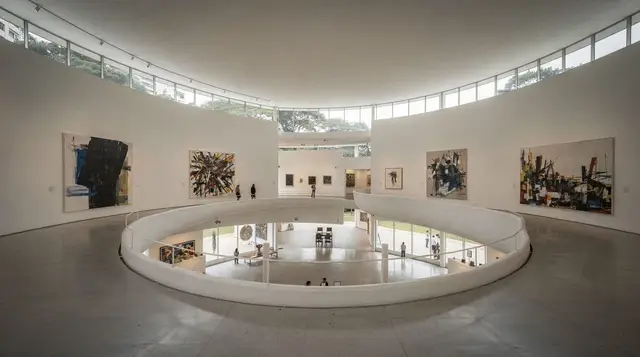
The Pinacoteca do Estado is the museum most visitors to São Paulo skip in favour of MASP, and that’s a mistake if Brazilian art is what you actually came to see. Where MASP’s strength is its European old masters, the Pinacoteca holds the country’s most complete survey of Brazilian painting and sculpture, from 19th-century academic portraiture through to the modernists who broke from it in the 1920s. It sits at the edge of Jardim da Luz, in a converted late-19th-century building that architect Paulo Mendes da Rocha reworked in the 1990s, adding steel-framed skylights that turned dim academic galleries into some of the best-lit exhibition rooms in the city. This guide covers what’s actually worth your time inside, and how to handle the Luz neighbourhood around it, which has a reputation that needs some honest context.
| Where | Praça da Luz 2, Luz, opposite Jardim da Luz park |
| Cost | Around R$20 (~US$4) full price; free on Saturdays |
| Time needed | 1.5–2 hours for the main collection |
| Getting there | Metro Luz (Line 1 Blue) or Tiradentes (Line 1 Blue), both a short walk |
| Best time | Weekday mornings; Saturdays if you want the free entry and don’t mind more people |
Start on the upper floor, not the ground floor
Most visitors enter and work through the ground-floor temporary exhibitions first, which is understandable but backwards if your time is limited. The permanent collection on the upper floors is the reason to come, and starting there means you see it while you’re still fresh rather than as an afterthought before closing time. Head straight for the stairs or lift to the top floor and work down — the layout is roughly chronological, so this also means you experience the collection in the order it was made, from 19th-century academic painting toward the modernist break of the 1920s.
The 19th-century rooms: bigger than they look from photos
The Pinacoteca’s academic collection is the country’s most complete, and it’s easy to underrate from a phone screen — canvases by Pedro Américo and Almeida Júnior were built for room-filling scale, with history paintings several metres wide depicting battles and colonial-era scenes. These aren’t subtle works, but they’re a useful baseline for understanding what Brazilian modernism was reacting against a generation later. Give this section 20–30 minutes even if figurative history painting isn’t usually your thing; the contrast makes the next rooms land harder.
The modernists: Tarsila do Amaral, Portinari, Segall
This is the collection’s real strength. The Pinacoteca holds significant works by the artists of Brazil’s 1920s modernist movement — Tarsila do Amaral’s bold, tropicalised colour and form, Cândido Portinari’s social-realist figures, Lasar Segall’s expressionist portraits brought from a European training into a distinctly Brazilian register, and Anita Malfatti, whose 1917 exhibition is often cited as the spark that set Brazilian modernism in motion. A private skip-the-line tour of the Pinacoteca is worth it specifically for this section — a guide can explain how these artists were responding to each other and to European movements in real time, context that isn’t always clear from wall text alone.
From an art-school gallery to the state’s flagship museum
The Pinacoteca’s roots go back further than its current building suggests. It was founded in 1905, originally tied to the Liceu de Artes e Ofícios, an arts-and-trades school, as a teaching gallery meant to give students access to a permanent collection of Brazilian painting and sculpture rather than existing as a standalone public museum from the start. That academic origin explains why its founding-era holdings lean so heavily toward the large-scale, technically formal history painting covered above — this was a collection built to be studied and copied by art students, not curated primarily for public spectacle.
Over the following decades it separated from the school and grew into the state of São Paulo’s own art institution, moving into its current Praça da Luz building, and by the time of the 1990s renovation it had become the most complete single record of Brazilian art history under one roof anywhere in the country — a status that’s arguably still underappreciated by visitors who default to MASP without knowing the Pinacoteca exists.
Anita Malfatti’s controversial 1917 show and the spark of Brazilian modernism
If one single event explains why the Pinacoteca’s modernist rooms matter as much as they do, it’s an exhibition that didn’t even happen at the Pinacoteca itself. In December 1917, the painter Anita Malfatti held a solo show in São Paulo of Expressionist and Cubist-influenced work she’d developed while studying in Germany and the United States — radically out of step with the academic realism Brazilian audiences and critics expected at the time. The influential writer Monteiro Lobato attacked the show in a widely read essay titled “Paranoia ou Mistificação?” (“Paranoia or Mystification?”), a harsh public takedown that, rather than ending Malfatti’s career, galvanised a circle of young writers and artists — including Mário de Andrade, Oswald de Andrade, and eventually Tarsila do Amaral — who rallied to her defence.
That circle went on to organise the 1922 Semana de Arte Moderna (Modern Art Week) in São Paulo, the event now credited as the formal launch of Brazilian modernism as an organised movement. The Pinacoteca’s modernist rooms, holding significant work by nearly everyone in that same circle, are effectively a physical record of the fallout from a single controversial exhibition — worth knowing before you walk past a Malfatti canvas assuming it’s simply “one of the modernists” rather than the specific spark that started the movement.
Paulo Mendes da Rocha’s 1990s renovation, in more detail
The transformation that turned a dim, dated early-20th-century palace into one of the best-lit museum spaces in the city wasn’t a cosmetic refresh — it was overseen by Paulo Mendes da Rocha, who’d go on to win the 2006 Pritzker Prize, architecture’s highest international honour, becoming only the second Brazilian architect to receive it after Oscar Niemeyer. His central intervention was structural as much as aesthetic: cutting steel-framed skylights into what had been a solid roof, flooding the upper galleries with the kind of consistent, shifting natural light that academic 19th-century paintings were originally intended to be seen under, rather than the flat artificial lighting most museums default to.
He also opened up interior circulation between floors, replacing some of the building’s original compartmentalised room-by-room layout with sightlines that let you sense the whole building’s scale from within a single gallery. It’s the same architect and broadly the same sensibility behind the Museu Brasileiro de Escultura in Jardins — see the architecture guide for more on Mendes da Rocha’s place in the Paulista School lineage that also produced Vilanova Artigas’s FAU-USP building.
Practical visitor tips: audio guides, café, and the gift shop
The Pinacoteca offers an audio guide covering the permanent collection’s key works, a reasonable middle ground between a full guided tour and reading wall labels alone if you’re visiting solo and want more context than the museum provides on-site by default. A café inside the building, with seating overlooking Jardim da Luz, is a genuinely pleasant stop for a coffee between the main building and Estação Pinacoteca rather than leaving the grounds entirely. The gift shop leans toward exhibition catalogues, art books and prints tied to the permanent collection’s modernist highlights — a better source for a genuinely distinctive souvenir than most generic tourist shops, particularly if a Tarsila do Amaral print or a book on Brazilian modernism appeals more than the usual keychains and magnets covered in the what to bring home from São Paulo guide.
Estação Pinacoteca, across the park
A five-minute walk across Jardim da Luz, the Pinacoteca’s second building — Estação Pinacoteca, in a former rail administration building — houses rotating contemporary shows and a smaller but genuinely worthwhile collection, including work connected to Brazilian modernist sculptor Victor Brecheret. A combined ticket usually covers both buildings, so check at the main entrance before you decide whether to make the crossing; it’s worth the extra 30–45 minutes if you have them.
The original 1900s building, before Mendes da Rocha
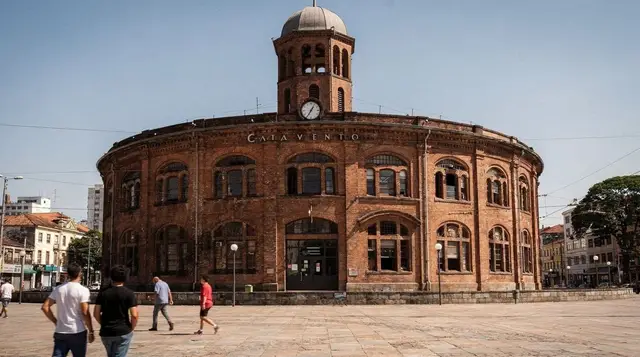
Mendes da Rocha’s 1990s intervention gets most of the architectural credit, but the building itself predates him by nearly a century. It was originally designed by Ramos de Azevedo, the single most prolific architect in São Paulo’s history and the figure behind an enormous share of the city’s landmark early-20th-century buildings, including the Theatro Municipal and the Mercado Municipal — see the architecture guide for more on his broader footprint. Ramos de Azevedo’s original design for what became the Pinacoteca was a fairly conventional eclectic academic building of its period, solid and dignified but architecturally unremarkable next to his more celebrated work elsewhere in the city.
That’s precisely what makes Mendes da Rocha’s later renovation so notable in isolation: rather than replacing or hiding the original structure, he worked with its existing masonry shell and reprogrammed the interior and roofline to completely change how the building functions and feels, without erasing Ramos de Azevedo’s original envelope. Standing in the ground-floor entrance hall, you’re looking at over a century of layered architectural decisions rather than a single coherent design moment — worth noticing if you’ve already read the architecture guide’s broader context on how São Paulo’s buildings tend to accumulate history rather than replace it outright.
Jardim da Luz: the park in between
Jardim da Luz itself, São Paulo’s oldest public park, dates to the 1820s and connects the two Pinacoteca buildings. It’s a pleasant place to sit for ten minutes between galleries, with mature trees and a small lake, though it’s also a spot where you’ll notice more visible homelessness than in wealthier parts of the city — a fact of downtown São Paulo worth being upfront about rather than pretending it isn’t there. During museum opening hours, with other visitors around, it’s a normal city park; treat it the way you would any downtown park anywhere and keep your phone in a pocket rather than in hand while walking through.
Being honest about Luz and Cracolândia
Luz has a reputation problem that’s worth addressing directly instead of dancing around it. A few blocks northwest of the museum, toward Avenida Ipiranga and Rua Helvétia, is the area known as Cracolândia — an open-air drug market that’s been a persistent feature of downtown São Paulo for decades despite repeated policy interventions. It has nothing to do with the museum or the park directly outside it, and during the day, the walk from Luz metro station to the Pinacoteca entrance doesn’t take you anywhere near it.
The honest advice: come during museum hours, walk directly between the station and the museum entrance rather than wandering the surrounding blocks, and treat this area with more caution after dark than you would Jardins or Vila Madalena. It isn’t a reason to skip the Pinacoteca — thousands of visitors do this without incident every week — but it’s a reason to be purposeful rather than aimless about your route. For the wider picture, see the honest answer on São Paulo safety.
Hours, prices, and the free Saturday
The Pinacoteca is open Tuesday to Sunday, closed Mondays, roughly 10am to 6pm with last entry before closing. Full admission runs around R$20 (about US$4) — genuinely inexpensive next to MASP — and the museum offers free entry on Saturdays, which draws a noticeably bigger crowd than a paid weekday but is still far calmer than MASP’s free Tuesdays. If a quiet, focused visit matters more to you than saving R$20, go on a weekday morning instead.
| Weekday visit | Saturday (free) | |
|---|---|---|
| Cost | ~R$20 (~US$4) | Free |
| Crowds | Light to moderate | Moderate, more families |
| Best for | Slow, uninterrupted viewing | Budget travellers |
| Combine with | Estação Pinacoteca same day | Jardim da Luz picnic |
How it compares to MASP
Visitors with limited time often ask which museum to prioritise, and the honest answer depends on what you actually want to see.
| Pinacoteca do Estado | MASP | |
|---|---|---|
| Strongest for | Brazilian art, 19th century to modernism | European old masters |
| Building | 1900s palace, Mendes da Rocha renovation | 1968 Lina Bo Bardi glass box |
| Cost | ~R$20, free Saturdays | ~R$50, free Tuesdays |
| Neighbourhood | Luz — go direct, be purposeful | Avenida Paulista — no special caution needed |
Full detail on MASP’s collection and the glass-easel display system is in the MASP guide; a wider comparison across all of São Paulo’s museums is in the São Paulo museums guide.
Frequently asked questions about visiting the Pinacoteca
Is the Pinacoteca worth visiting if I’ve already seen MASP?
Yes — they cover different ground almost entirely. MASP is strongest in European old masters; the Pinacoteca holds Brazil’s most complete survey of its own art history, including the 1920s modernist movement that MASP doesn’t really cover.
How much time do I need?
1.5 to 2 hours for the main building alone, or up to 3 hours if you also cross Jardim da Luz to Estação Pinacoteca.
Is the area around the museum safe?
Yes, during opening hours, if you go directly between the metro and the museum entrance. Avoid wandering toward Cracolândia, a few blocks northwest, particularly after dark — see is São Paulo safe for the wider context.
What’s the best day to visit for free?
Saturday, when entry is free. It’s busier than a weekday but still calmer than MASP’s free Tuesdays.
Are Estação Pinacoteca and the main building covered by one ticket?
Usually yes — check at the entrance, since policies occasionally change. It’s a five-minute walk across the park and worth the extra time if you have it.
Can I see the Pinacoteca and Museu da Língua Portuguesa in the same visit?
Yes, easily — both sit right around Praça da Luz. See the Museu da Língua Portuguesa guide for what’s inside, housed a short walk away in the historic Estação da Luz train station.
Is the Pinacoteca good for people who don’t normally like art museums?
It’s a reasonable entry point specifically because of the modernist rooms — Tarsila do Amaral’s work in particular tends to land with people who find academic painting hard going. Give the upper-floor 20th-century rooms priority if that’s you.
Who designed the Pinacoteca’s 1990s renovation?
Paulo Mendes da Rocha, who won the 2006 Pritzker Prize — his intervention added the steel-framed skylights that give the upper galleries their distinctive natural light, and opened up interior sightlines between floors.
Fitting the Pinacoteca into a longer trip
The Pinacoteca works well as a downtown morning alongside Centro Histórico and the historic centre more broadly, since Luz is a short walk or one metro stop from Praça da Sé. On a three-day itinerary, pair it with the Museu da Língua Portuguesa and a downtown lunch before moving on to Avenida Paulista in the afternoon. Art-focused travellers following the art and architecture itinerary should treat the Pinacoteca as a required stop alongside MASP and the Bienal pavilion in Ibirapuera — together they cover Brazilian and international art from the 19th century to today.
Museum & art tours on GetYourGuide
Verified deep-linked GetYourGuide tours. Book through these links and we earn a small commission at no cost to you.
These are our own photographs of São Paulo, not the operator's pictures of this tour — open the tour page to see those.