The São Paulo Bienal
What is the São Paulo Bienal, and how do I know if it's running during my visit?
It's a major international contemporary art exhibition held in the Ciccillo Matarazzo Pavilion in Ibirapuera Park, typically running from September through December in odd-numbered years — it isn't a permanent museum. Check the current edition's dates on the Bienal's own site before you plan a visit around it, since the schedule has shifted in past editions.
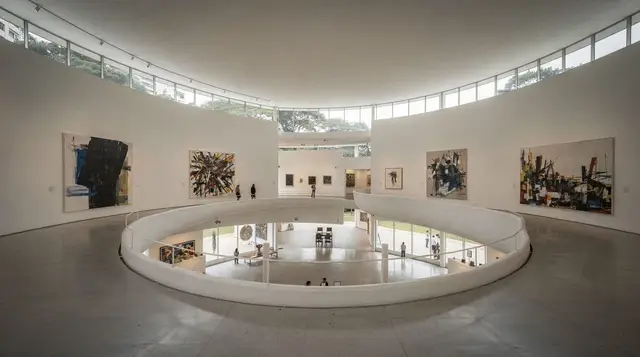
The São Paulo Bienal is the second-oldest contemporary art biennial in the world after Venice, running since 1951, and it remains one of the most significant events on the international contemporary art calendar despite being far less known to casual visitors than the city’s permanent museums. Held inside Oscar Niemeyer’s Ciccillo Matarazzo Pavilion in Ibirapuera Park — a building whose sweeping curved ramps are worth seeing even without an exhibition inside — the Bienal is free, runs for several months every other year, and typically draws a major international curator and dozens of participating artists from across the world. This guide covers what it actually is, when it runs, and how to plan around a schedule that isn’t permanent the way a normal museum’s hours are.
| Where | Ciccillo Matarazzo Pavilion, Ibirapuera Park |
| Cost | Free |
| Time needed | 2–4 hours depending on the scale of the current edition |
| Getting there | Bus or rideshare to Ibirapuera; a walk from the nearest gate to the pavilion |
| Best time | Weekday mornings during the exhibition’s run, typically September–December in odd years |
Not a permanent museum — check the calendar first
The single most important thing to know before planning a visit: the Bienal isn’t a year-round exhibition. It runs on a roughly two-year cycle, historically held in odd-numbered years from around September through early December, though exact dates have shifted between editions and are set independently for each one. If your trip doesn’t fall within an active edition’s dates, the pavilion itself is still worth a look from outside for the architecture, but there won’t be an exhibition to walk through. Check the current Bienal’s official dates before building a day around it — don’t rely on a fixed calendar assumption from a past edition.
The building: one of Niemeyer’s most important works
Even if you land outside an active edition, the Ciccillo Matarazzo Pavilion deserves attention on its own. Designed by Oscar Niemeyer as part of Ibirapuera Park’s broader modernist complex, its long, sweeping form and dramatic internal ramps were built specifically to host large-scale exhibitions without interior columns breaking up the space — an engineering statement as much as an architectural one. During an active Bienal, artists frequently respond to this open, ramp-dominated architecture directly, building installations that use the building’s scale rather than fighting against it, which is part of what makes the Bienal feel different from a conventional museum show.
What to expect inside during an active edition
Each Bienal edition is organised around a curatorial theme set by that year’s chief curator, with dozens of participating artists from Brazil and internationally responding to it across painting, sculpture, video, installation, and performance. Editions vary considerably in scale and tone from one to the next — some lean heavily conceptual and political, others more visual and immersive — so it’s worth reading a short overview of the current edition’s theme before you go, since it changes how the work reads. Expect a few hours minimum for a proper walk-through of a major edition; some visitors return more than once during a single run.
A history longer than almost any other biennial in the world
The São Paulo Bienal launched in 1951, founded by industrialist and arts patron Francesco “Ciccillo” Matarazzo Sobrinho — whose name the pavilion now carries — making it the second-oldest recurring biennial exhibition in the world after Venice’s, which began in 1895. Over more than seven decades, the Bienal has hosted work from a huge range of major international and Brazilian artists, and it’s played a significant role in exposing Brazilian audiences to global contemporary art movements while also giving Brazilian and Latin American artists a platform reaching well beyond the country’s own borders.
Editions have occasionally been shaped by Brazil’s own political history — including tension and boycotts during the country’s military dictatorship era in the 1960s and 70s — which the Bienal’s own historical materials address directly rather than glossing over. Knowing this history adds real weight to a visit; this isn’t simply a contemporary art fair, it’s a seven-decade institution that’s tracked much of Brazil’s cultural and political story alongside the art itself.
What a typical edition actually feels like to walk through
First-time visitors sometimes underestimate the sheer physical scale of a major Bienal edition — the Ciccillo Matarazzo Pavilion spans multiple floors connected by Niemeyer’s sweeping ramps, and a substantial edition can include hundreds of individual works spread across the entire building. Expect a mix of formats within a single visit: large-scale sculptural installations that use the pavilion’s open floor plan directly, video and sound pieces requiring you to slow down and spend real time with a single work, and more conventional painting or photography hung in sequence. The open, largely column-free layout means there’s rarely a single obvious route through the exhibition — many visitors wander somewhat freely between sections rather than following a strict numbered path, which suits the Bienal’s generally exploratory curatorial spirit better than a rigid museum-style circuit would.
Why the Bienal matters beyond São Paulo itself
The São Paulo Bienal’s significance extends well past being a large local exhibition — it’s historically served as one of the primary gateways connecting Latin American contemporary art to the wider international art world, and vice versa, giving global audiences early exposure to Brazilian and regional artists who later went on to major international careers. For visitors with even a casual interest in contemporary art, catching an active edition offers a genuinely rare opportunity: seeing a globally significant exhibition in a context most international art tourism doesn’t typically reach, since São Paulo doesn’t carry the same reflexive art-world name recognition as Venice, Basel, or Kassel despite hosting an event with comparable historical pedigree.
Tips for a first-time Bienal visitor
Pace yourself — a major edition genuinely rewards two shorter visits over one exhausting marathon walk-through if your schedule allows it, since the sheer volume of work across a large edition makes it easy to reach a point of diminishing attention after two or three hours. Bring a notebook or use your phone to jot down artist names and works that catch your interest, since wall labels can be sparse in places and it’s easy to lose track of what struck you by the time you’re back at the hotel. Comfortable shoes matter more here than at most museums — the ramps that make the building architecturally distinctive also mean a fair amount of walking and gradual elevation change across a full visit.
Guernica in São Paulo: the 1953 edition’s defining moment
The Bienal’s early reputation was cemented fast. At the second edition in 1953, organised to mark São Paulo’s own 400th anniversary year, Ciccillo Matarazzo secured the loan of Picasso’s Guernica — at the time one of the most politically charged and internationally significant paintings of the 20th century — for display alongside a major Picasso retrospective spanning the artist’s career. For a Brazilian public with limited access to European modernist masterworks in person, seeing Guernica in Ibirapuera Park was a genuinely landmark cultural moment, and it’s frequently cited by historians as the point where the young Bienal proved it could operate on the same level as Venice rather than as a regional imitation. It’s a useful data point for understanding why the Bienal carries more institutional weight in art history than its relatively low profile among casual international visitors might suggest.
The 1969 boycott and the dictatorship years
Not every edition ran smoothly. By 1969, five years into Brazil’s military dictatorship, the regime’s escalating censorship and human rights abuses had drawn international condemnation, and that year’s Bienal became a flashpoint: artists and entire national delegations from France, the United States, Argentina and elsewhere withdrew or boycotted the edition in protest, a coordinated action that came to be known informally as the “art strike” against Brazil’s cultural institutions.
The Bienal went ahead in a diminished form, and the episode remains one of the clearest examples of how the country’s political history directly shaped an event usually discussed purely in art-world terms. The Bienal’s own historical materials and later curatorial statements have returned to this period repeatedly, treating it as a formative rupture rather than an embarrassment to smooth over — part of why the institution today tends to engage political and social themes directly in its curatorial choices rather than avoiding them.
The same patron who built São Paulo’s other major art museum
Francesco “Ciccillo” Matarazzo Sobrinho’s imprint on São Paulo’s art infrastructure extends well beyond the Bienal itself. Before founding the biennial in 1951, Matarazzo had already established the Museu de Arte Moderna de São Paulo (MAM) in 1948, and the two institutions grew up together, sharing patrons, curatorial staff and, for years, physical space inside Ibirapuera Park before MAM moved to its current pavilion nearby. Understanding this shared origin explains why a Bienal visit pairs so naturally with a stop at MAM if it’s open during your trip — both institutions trace back to the same mid-century push, largely driven by one wealthy industrialist family, to give São Paulo a contemporary art infrastructure that Rio de Janeiro didn’t yet have at the time, part of the broader mid-20th-century rivalry between the two cities covered in the São Paulo vs Rio de Janeiro guide.
Practical tips for visiting during a major edition
Major editions typically run a free education programme alongside the exhibition itself — scheduled guided walkthroughs, often multiple times daily, led by trained mediators who explain individual works and the curatorial throughline connecting them, usually included at no extra cost beyond the free general admission. These scheduled tours run in Portuguese most of the time, with English-language slots less frequent and worth checking for specifically if you don’t speak Portuguese, since the mediators’ context adds considerably more than reading wall labels alone.
Large editions can also involve queuing at peak weekend hours, particularly in the exhibition’s final weeks as visitors realise time is running out — a weekday morning visit avoids this almost entirely. Photography is generally permitted throughout for personal, non-commercial use, though flash and tripods are usually restricted around video and light-sensitive installations; check the current edition’s specific rules at the entrance rather than assuming a blanket policy.
Combining a Bienal visit with the rest of Ibirapuera
Because the pavilion sits inside Ibirapuera Park, a Bienal visit combines naturally with the park’s other attractions — Museu Afro Brasil and the Museu de Arte Moderna are both a short walk away, and the park’s gardens and lakes make for an easy break between exhibition halls. See the complete Ibirapuera Park guide for a route that sequences all of this without unnecessary backtracking across the park’s considerable size.
| Bienal (active edition) | Museu Afro Brasil | |
|---|---|---|
| Schedule | Roughly Sept–Dec, odd years | Every day it’s open, year-round |
| Cost | Free | Free |
| Focus | International contemporary art | Afro-Brazilian history and art |
| Building | Niemeyer’s Ciccillo Matarazzo Pavilion | Niemeyer’s Pavilhão Padre Manuel da Nóbrega |
How the Bienal ranks among the world’s major recurring exhibitions
Casual visitors sometimes assume the São Paulo Bienal is a large local event rather than a globally significant one, largely because São Paulo doesn’t carry the same reflexive art-world name recognition as Venice, Kassel or Basel. The Bienal’s own credentials argue otherwise.
| São Paulo Bienal | Venice Biennale | Documenta (Kassel) | |
|---|---|---|---|
| Founded | 1951 | 1895 | 1955 |
| Frequency | Every 2 years | Every 2 years | Every 5 years |
| Rank by age | 2nd oldest recurring biennial | Oldest | Younger than both |
| Cost to visit | Free | Paid entry | Paid entry |
| Typical international profile among casual travellers | Lower than its historical weight | Very high | Moderate |
The gap between the Bienal’s institutional standing and its actual visibility to international tourism is exactly why it’s worth prioritising if your trip happens to line up with an active edition — you’re getting access to an exhibition with real curatorial weight and a nearly eight-decade track record, without the crowds or ticket costs that come with its European counterparts.
How it fits with São Paulo’s other major contemporary art moments
If your visit doesn’t line up with the Bienal, São Paulo’s contemporary scene doesn’t disappear entirely — the city’s commercial gallery scene in Jardins and Pinheiros runs year-round, and the SP-Arte fair, usually held every April at the same pavilion, offers a smaller but still substantial concentrated look at the contemporary market in years without an active Bienal edition.
Frequently asked questions about visiting the São Paulo Bienal
When does the São Paulo Bienal run?
Typically September through early December in odd-numbered years, though exact dates vary by edition — check the current year’s official schedule before planning around it.
Is the Bienal free to visit?
Yes, entry is free during an active edition’s run.
What if my visit doesn’t line up with an active edition?
The Ciccillo Matarazzo Pavilion is still worth seeing from outside for the Niemeyer architecture, but there won’t be an exhibition inside — consider the São Paulo art galleries guide or Museu Afro Brasil as year-round contemporary and historical alternatives.
How long does a Bienal visit take?
2 to 4 hours for a proper walk-through of a major edition, depending on its scale — some visitors split it across two shorter visits if the exhibition is particularly large.
Is the Bienal good for visitors without an art background?
Yes — editions vary in accessibility, but the sheer scale and variety of work on display, combined with the building itself, makes for an engaging visit even without deep contemporary art knowledge going in.
Can I combine a Bienal visit with Museu Afro Brasil in one day?
Yes, easily — both sit inside Ibirapuera Park within walking distance of each other, making for a strong full day focused on art and history.
Is the pavilion accessible for wheelchair users?
Yes, generally — Niemeyer’s ramp-based design, built to move large volumes of exhibition visitors, tends to be more accessible than stair-heavy older buildings, though specific installations during an active edition can occasionally alter circulation.
Are there free guided tours during an active edition?
Usually yes — major editions run a free education programme with scheduled mediator-led walkthroughs, mostly in Portuguese, with fewer English-language slots that are worth checking for in advance if you don’t speak Portuguese.
Fitting the Bienal into a longer trip
If your trip timing aligns with an active edition, treat the Bienal as a priority stop on the art and architecture itinerary, paired with MASP, the Pinacoteca, and the rest of Ibirapuera’s Niemeyer buildings in the same trip. On a standard three-day itinerary, it fits into a park-focused morning alongside Museu Afro Brasil, with the afternoon left free for Vila Madalena or Pinheiros.
Museum & art tours on GetYourGuide
Verified deep-linked GetYourGuide tours. Book through these links and we earn a small commission at no cost to you.
These are our own photographs of São Paulo, not the operator's pictures of this tour — open the tour page to see those.