Parque Ibirapuera: a complete guide
What makes Parque Ibirapuera worth a visit?
It's São Paulo's answer to Central Park — a large, well-maintained green space that also houses several major cultural institutions (MAM, the Bienal pavilion, the Afro Brasil Museum, the Ibirapuera Planetarium) within its grounds, so you can combine a walk or bike ride with genuine museum-going in a single visit. It's free to enter and one of the best free things to do in the city.
Parque Ibirapuera is São Paulo’s most important urban park, and unusually for a green space, it’s also a genuine cultural destination in its own right — several of the city’s major museums and cultural venues sit inside its grounds, alongside lakes, cycling paths, sports courts and the kind of everyday Sunday scene that tells you more about how paulistanos actually live than most formal sightseeing. It’s free to enter, easy to reach, and worth building a half-day or more around.
| Where | Ibirapuera neighbourhood, bordering Moema and Vila Mariana |
| Cost | Free entry to the park; museums inside charge separately, typically R$10–20 |
| Time needed | Half a day minimum, a full day if visiting multiple museums |
| Getting there | Metro to Ibirapuera or AACD-Servidor (Line 5), or bus |
| Best time | Weekday mornings for quiet, Sunday for the fullest local atmosphere |
Layout and getting oriented
Spend the first few minutes of any visit simply orienting yourself against a park map, either physical or on your phone, since the sheer scale of Ibirapuera means a wrong turn can cost real time you’d rather spend actually enjoying the park.
The park is large enough that a first-time visit benefits from picking a focus rather than trying to see everything — the main lake and its surrounding paths sit roughly central, with the cluster of museums and cultural buildings concentrated toward the Avenida Pedro Álvares Cabral entrance. Bicycle rental stations are scattered throughout and are the most efficient way to cover real ground if you want to see multiple corners of the park in one visit rather than committing to a single area on foot.
The museums inside the park
Buy tickets for any of these in advance where possible, particularly on weekends, since queues can build quickly for the more popular exhibitions.
This is what genuinely sets Ibirapuera apart from a typical city park. The Museu de Arte Moderna (MAM) sits just inside one of the main entrances; the Oscar Niemeyer-designed Bienal pavilion hosts the São Paulo Bienal art exhibition in alternating years and other events in between, detailed in the São Paulo Bienal guide; the Museu Afro Brasil, covering Afro-Brazilian art and history, is one of the more underrated museums in the city, covered in the Museu Afro Brasil guide; and the Ibirapuera Planetarium rounds out the cultural cluster. It’s genuinely possible to spend a full day here between the park itself and two or three of these museums.
Cycling and the bike tour option
Sundays in particular see one of the city’s main avenues nearby close to car traffic, which many cyclists use as a natural extension to a longer Ibirapuera ride, combining the park’s paths with a stretch of open road otherwise dominated by vehicles.
Ibirapuera’s paved paths and generally flat terrain make it one of the best cycling spots in the city, whether on a rented bike from one of the in-park stations or via a guided option like the Ibirapuera Park bike tour, which covers the park’s highlights with context you’d miss riding solo. For a broader look at cycling and running culture in the city, see running and cycling in São Paulo.
Ibirapuera versus São Paulo’s other major parks
| Ibirapuera | Parque Villa-Lobos | Cantareira State Park | |
|---|---|---|---|
| Size and terrain | Large, flat, formal park | Large, flat, along the Pinheiros river | Vast, forested, hilly |
| Best for | Museums, cycling, people-watching | Cycling, riverside walks | Hiking, nature immersion |
| Getting there | Metro Ibirapuera, central | Slightly further west, needs a car or longer transit | Requires a dedicated trip, further from centre |
Full comparison of the city’s parks generally is in the best parks in São Paulo.
The park’s architecture and design history
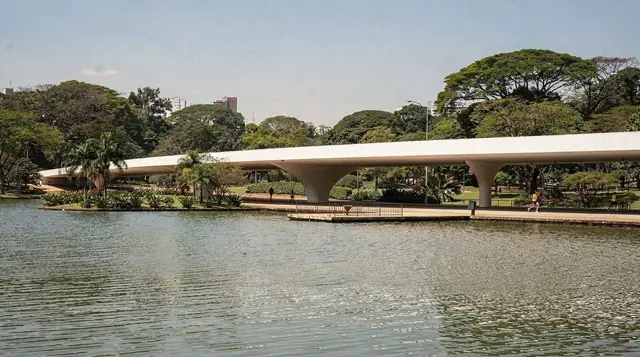
Ibirapuera’s design carries real architectural significance beyond its function as a green space — the park was developed for São Paulo’s 400th anniversary celebrations in 1954, with several of its buildings designed by Oscar Niemeyer, Brazil’s most internationally renowned architect. The distinctive marquise, a long, sinuous covered walkway connecting several of the park’s buildings, is one of Niemeyer’s more recognisable Brazilian works outside Brasília, and it’s worth pausing to appreciate as architecture in its own right, not just a functional walkway between destinations. For visitors interested in Niemeyer’s broader body of work in the city, see Oscar Niemeyer in São Paulo.
Combining the park with a broader city tour
If Ibirapuera is one stop among several on a fuller day of sightseeing, the must-see sites walking tour or the evening-oriented premium city bus tour with dinner both work well as bookends to an independent park visit.
Sports facilities and everyday recreation
Beyond cycling and walking paths, Ibirapuera has a genuinely extensive set of sports facilities woven through the park — basketball and volleyball courts, a running track, and open lawns that see informal football and frisbee games most weekends. This everyday recreational use is part of what makes the park feel alive rather than purely ornamental; on any given afternoon you’ll see organised exercise classes, informal sports games and solo runners all sharing the same space without much friction, a reflection of how central the park is to daily paulistano life rather than existing purely for visitors.
Sunday atmosphere
Sunday is when Ibirapuera is at its most alive — families, joggers, capoeira circles, food vendors and a genuinely festive, unhurried energy that’s different from the weekday version of the same park. If you want to see São Paulo at its most relaxed and communal, a Sunday morning here is one of the better ways to do it, and it pairs naturally with the wider Sunday routine covered in how to spend a Sunday in São Paulo.
The Japanese pavilion and other cultural corners
Beyond the major museums, Ibirapuera holds a scattering of smaller cultural spots worth seeking out, including a Japanese pavilion (Pavilhão Japonês) built as a gift marking Japanese immigration to Brazil, reflecting the strong Japanese-Brazilian community connection covered more broadly in Japanese São Paulo. These smaller sites don’t demand much time individually but add texture to a longer visit, particularly for anyone who’s already spent a couple of hours in the park and wants to explore beyond the main lake and museum cluster.
Food and refreshments inside the park
Food options within Ibirapuera range from casual kiosks selling snacks, coconut water and ice cream scattered along the main paths, to a couple of more substantial café and restaurant options near the museum cluster. It’s generally sensible to bring your own water, particularly in summer heat, even though kiosks are reasonably well distributed — queues can build at the busiest points on weekend afternoons. For a more substantial meal, most visitors head to nearby Moema or Vila Mariana rather than relying entirely on in-park options, both within a short walk or rideshare of the park’s main entrances.
Photography and the best viewpoints
The park offers several genuinely photogenic spots beyond the obvious lake views — the marquise walkway, the reflecting pools near the museum buildings, and the skyline views visible from more open lawn areas where the city’s towers frame the park’s greenery. Early morning light, before the midday sun becomes harsh, tends to produce the best results, and it coincides with the quietest, least crowded time to visit if photography without crowds in frame matters to you.
Ibirapuera through the seasons
Ibirapuera changes character noticeably across São Paulo’s year, and timing a visit around the season shapes the experience more than most visitors expect from a city park. Spring (September-November) is arguably the park’s best season for pure visual impact — ipê trees scattered throughout the grounds bloom in vivid yellow and pink, a citywide spring event that Ibirapuera showcases particularly well given its scale, though afternoon rain becomes increasingly likely as the season progresses.
Autumn (April-June), widely considered São Paulo’s most pleasant season generally, gives the clearest skies and most comfortable temperatures for a full day of walking or cycling without summer’s heat or spring’s rain risk. Winter (July-August) stays dry and mild, ideal for extended outdoor activity, though mornings can start cool enough to want a light layer. Summer (December-March) demands the most planning: heat builds through the morning, and the late-afternoon storms that define a São Paulo summer arrive reliably enough that a summer visit works best scheduled for early morning, wrapped up well before early-to-mid afternoon.
How Ibirapuera compares to other South American capital parks
For visitors who’ve spent time in other big South American cities, a numbers comparison helps calibrate expectations. Ibirapuera covers roughly 1.6 square kilometres, smaller than Buenos Aires’ combined Palermo park system but broadly comparable to a single major section of it, and considerably smaller than Bogotá’s Parque Simón Bolívar, one of the largest urban parks in South America. What sets Ibirapuera apart isn’t raw size but density of cultural content within its footprint — the concentration of major museums inside a single park boundary is unusual even by the standards of large capital-city parks elsewhere in the region.
| Park | City | Approx. size | Standout feature |
|---|---|---|---|
| Ibirapuera | São Paulo | ~1.6 km² | Multiple major museums inside the park |
| Palermo parks | Buenos Aires | Larger combined area | Rose garden, lakes, planetarium |
| Parque Simón Bolívar | Bogotá | Considerably larger | Sports facilities, open lawns |
| Bosque de Chapultepec | Mexico City | Much larger | Castle, multiple museums, zoo |
A common mistake: underestimating the walking distances
The single most common mistake first-time Ibirapuera visitors make is treating it like a normal city park you can casually stroll across in twenty minutes. The distance from the Avenida Pedro Álvares Cabral entrance and museum cluster to the far side of the park near Vila Mariana genuinely takes 30-40 minutes on foot at a normal walking pace, and covering the park’s full loop plus stops at two or three attractions can easily add up to 6-8km of walking over a visit. Visitors arriving with a tight schedule and planning to “quickly see the park” between other stops routinely underestimate this, then either rush through unsatisfyingly or run over their planned time. The practical fix is picking a single entrance and area to focus on rather than trying to see the whole park in one visit — or renting a bike from one of the in-park stations if covering more ground genuinely matters, which cuts the same distance down to a fraction of the walking time.
Weekday mornings versus Sunday: two very different parks
It’s worth being deliberate about which version of Ibirapuera you want, since weekday mornings and Sunday are close to two different experiences in the same space. A Tuesday or Wednesday morning gives a genuinely quiet park — joggers, a scattering of retirees, minimal queues at the museums, and enough space that photography without crowds in frame is straightforward. Sunday flips that completely: the park fills with families, food vendors, capoeira circles and a citywide cross-section of paulistanos treating the park as the default weekend destination it’s long served as, which makes for a livelier, more atmospheric visit but a noticeably more crowded one, particularly around the lake and main museum entrances by mid-morning. Neither is objectively better — it depends on whether you’re prioritising a calm walk or a slice of how the city actually spends its weekends.
Practical safety and lost-property basics
Ibirapuera is well-patrolled and heavily used, which keeps it among the safer large public spaces in the city, but ordinary precautions still apply, particularly after dark when the park’s crowd thins and lighting is uneven away from the main paths. Stick to well-used paths and the areas around the lake and museum cluster if visiting in the evening, and treat a night-time visit as a shorter, more targeted trip rather than a long wander the way you might during the day. If you lose something inside the park, the museum reception desks and any staffed entrance gate are the first place to check — items handed in by other visitors or found by park staff typically get logged centrally rather than staying wherever they were found, so it’s worth checking more than one location if your first stop doesn’t turn anything up.
Frequently asked questions about Parque Ibirapuera
What are the opening hours?
The park is open daily, roughly 5am to midnight, though most visitors come during daylight hours; individual museums inside keep their own separate hours, typically 10am–5pm or 6pm, closed Mondays.
Is entry to the park free?
Yes, entry to the park itself is free; only the museums and specific paid activities inside charge separately.
How much time should I budget?
A minimum of two to three hours for the park alone; a full day if you want to properly visit two or more of the museums inside.
Is Ibirapuera safe?
Yes, it’s well-patrolled, busy and generally considered one of the safer green spaces in the city, particularly during daylight hours.
What’s the best entrance to use?
The Avenida Pedro Álvares Cabral entrance puts you closest to the main museum cluster; the Portão 10 entrance near the metro station is the most convenient if arriving by public transport.
Is it good for families?
Yes — playgrounds, open lawns, the planetarium and generally easy, flat walking paths make it one of the more family-friendly major attractions in the city.
Which museum should I prioritise if I only have time for one?
MAM is the most straightforward choice for general contemporary art interest, while the Museu Afro Brasil is the stronger pick if you want a museum visit that connects more directly to Brazilian history and identity specifically.
Is the park accessible for visitors with mobility needs?
Largely yes — the main paths are paved and flat, making Ibirapuera one of the more accessible major green spaces in the city, though some areas near the lake and forested edges are less consistently paved.
Fitting Ibirapuera into your trip
Ibirapuera works well as a half-day stop on almost any itinerary length. On a three-day itinerary, pair it with a museum visit inside the park itself to make the most of a single stop. On a one-day itinerary, a shorter visit — the lake and gardens without a museum detour — still fits comfortably alongside other highlights. For families specifically, see São Paulo with kids for how the park fits into a broader family-friendly day.
Hiking & nature tours on GetYourGuide
Verified deep-linked GetYourGuide tours. Book through these links and we earn a small commission at no cost to you.
These are our own photographs of São Paulo, not the operator's pictures of this tour — open the tour page to see those.