Pixação: São Paulo's other street writing
What is pixação and how is it different from São Paulo's street art?
Pixação is a distinct São Paulo tag-writing style — tall, angular black letters climbing building façades, often high up and hard to reach — that grew out of the city's punk and metal scenes in the 1980s. It is not the same as the painted murals at Beco do Batman or Vila Madalena, which are a separate, tolerated street-art tradition; pixação is closer to a coded, adrenaline-driven signature system, and it remains illegal and controversial.
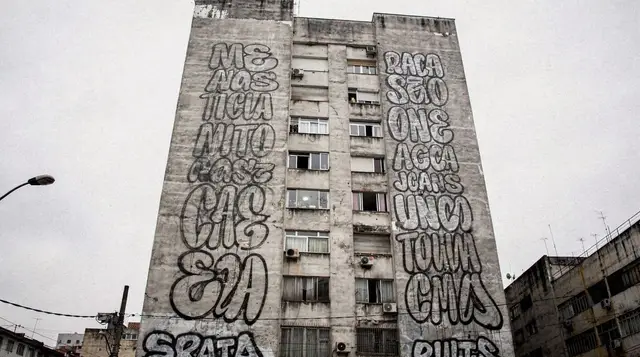
Look up at almost any São Paulo building over five storeys and you’ll see it: tall, spiky black letters climbing the façade, sometimes dozens of storeys above street level, in a jagged script that looks more like runic code than graffiti. That’s pixação, and it confuses most first-time visitors, who assume it’s either vandalism or the same thing as the painted murals a few blocks away. It’s neither, exactly, and understanding the difference will change how you read the city for the rest of your trip.
| What | Angular black tag-writing (pixo), distinct from painted street art |
| Where you’ll see it | Almost everywhere — downtown high-rises, Avenida Paulista, overpasses, abandoned buildings |
| Legal status | Illegal; a criminal offence under Brazilian law |
| Best places to see it discussed/contextualized | Beco do Batman area, guided street-art tours, some gallery shows |
| Should you photograph it | Yes, from the street — don’t climb or trespass to get closer |
A script born from the city’s punk scene
Pixação (from pichar, “to tar” or “to stain”) started in the late 1970s and early 1980s, tangled up with São Paulo’s punk and heavy metal subculture. Early pixadores borrowed lettering from album covers and metal-band logos — sharp, runic, deliberately illegible to outsiders — and used it to mark territory the same way graffiti writers elsewhere used bubble letters and wildstyle. Over four decades it evolved into its own self-contained typographic system, with regional variations between São Paulo crews and rules about how and where a name can legally (within the subculture’s own logic) be written over.
What sets pixação apart from graffiti traditions in most other cities is where it goes. Pixadores climb — building façades, water towers, bridge supports, the upper floors of abandoned high-rises — using improvised ropes, gutters, and window ledges, often at night and often at real physical risk. Height is the point: a tag fifteen storeys up a downtown tower is a flex that a ground-level piece never can be. Fatal falls happen most years. This isn’t presented here to romanticize the risk, but because it explains why pixação reads as more confrontational than the painted murals nearby — it’s frequently an act of trespass and danger by design, not decoration.
Why it’s not the same as São Paulo’s painted street art
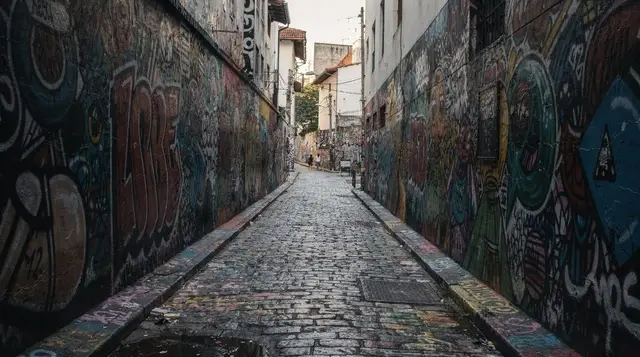
Visitors often lump pixação together with the murals of Beco do Batman or the colourful walls of Vila Madalena and Pinheiros, but the two scenes are largely separate, sometimes in open tension with each other. Painted street art (grafite, closer to the international “graffiti” as commissioned mural) is broadly tolerated and even commissioned by building owners and the city — it’s what shows up in the São Paulo street art guide and on organized tours. Pixação is not commissioned, not asked for, and stays illegal regardless of the wall’s owner. Some pixadores view painted muralists as sellouts working for developers; some muralists have had their pieces tagged over by pixadores as a territorial statement. Reading the wall in front of you — is it a bright, figurative mural, or dense black lettering — tells you which tradition you’re looking at and roughly what its social status is.
A street art bike tour is the fastest way to see both traditions side by side with someone who can explain the distinction as you ride, since the two often sit on the same block.
Where you’ll actually encounter it
Pixação is genuinely everywhere in central São Paulo, which is different from most of the deliberately curated street art you’ll seek out. The abandoned or underused high-rises around Centro Histórico carry decades of layered tags. Overpasses and underpasses on the Marginal Tietê and Marginal Pinheiros expressways are covered floor to sky. Even relatively affluent stretches of Avenida Paulista have ground-floor pixação on shuttered storefronts and construction hoarding. You don’t need to seek it out; it will be part of the visual texture of nearly every neighbourhood you walk through, which is itself part of the point pixadores make — that the city’s surfaces belong to everyone, not just to property owners.
The internal rules pixadores live by
Pixação looks chaotic from the street, but the subculture runs on a surprisingly rigid internal code that most visitors never hear about. Each pixador develops a personal assinatura (signature) — a distinct lettering style built from the shared runic-metal alphabet but individualised enough that other pixadores can identify who wrote it without a name attached, the same way graffiti writers elsewhere develop a recognisable hand. Pixadores usually operate as part of a grife or crew, often taking a shared crew tag alongside an individual one, and status within the scene is earned largely through height and risk rather than artistic polish — a tag fifteen storeys up carries more weight than a technically neater one at eye level.
Writing over another pixador’s tag is treated as a genuine act of disrespect within the subculture’s own logic, roughly equivalent to graffiti’s “going over” etiquette in cities like New York, and can trigger real friction between crews. None of this is visible or explained on the wall itself, which is exactly why it tends to surprise visitors who assume it’s random defacement rather than a scene with its own hierarchy, reputations and unwritten rules governing who gets to write where.
The 2008 Bienal invasion, in more detail
The most-cited flashpoint in pixação’s relationship with the institutional art world happened at the 28th São Paulo Bienal in 2008, curated around an unusually open, unfinished-feeling exhibition concept by chief curator Ivo Mesquita, who left much of the Ciccillo Matarazzo Pavilion’s vast floor space deliberately empty as a statement about the crisis of biennial-format exhibitions. A group of pixadores treated the near-empty walls as an invitation, entering without authorisation and covering sections of the pavilion in tags during the exhibition’s run — an act some read as a savvy, almost inevitable response to a show that had literally left blank walls in one of the city’s most-visited cultural buildings, and others read as straightforward vandalism of a public institution.
The organisers’ response was notably mixed rather than purely punitive; the incident became a genuine talking point in Brazilian art criticism for years afterward, cited regularly in debates about who gets institutional legitimacy and on what terms. It’s worth bringing up if you visit an active edition of the São Paulo Bienal yourself — many guides and even some wall texts still reference it as a turning point in how the institution thinks about outsider art practices.
From São Paulo’s rooftops to European galleries
Pixação’s reach now extends well beyond the city that invented it. The 2009 documentary Pixo, directed by João Wainer and Roberto T. Oliveira, brought the practice to international film festival audiences and remains the most widely cited primary source for anyone researching the scene seriously — it follows several pixadores climbing buildings at night and talking candidly about the risk, the politics and the appeal.
Individual pixadores have since built careers straddling both worlds: Djan Ivson, known as Cripta Djan, went from writing on São Paulo high-rises to showing invited work in European galleries and museums, a trajectory that’s become a reference point in ongoing debates about whether gallery recognition validates or defangs a practice built on refusing permission in the first place. Exhibitions and academic interest in pixação have appeared periodically in Berlin, Paris and elsewhere since the 2010s, generally framed as an outsider art movement worth serious study rather than a curiosity — though, as covered above, that framing remains genuinely contested within the scene itself.
How to visually tell pixação styles apart
For a first-time visitor, most pixação reads as one undifferentiated block of black lettering, but a few visual cues separate styles once you know to look for them. Older, more traditional tags tend toward extremely tall, narrow letterforms stacked close together, deliberately hard to read even for other paulistanos — this is the style most directly descended from the 1980s metal-album-cover aeshetic. Newer work sometimes incorporates more rounded or bubble-influenced letterforms showing crossover influence from international graffiti styles, particularly among younger writers active since the 2010s.
Scale and placement matter as much as letterform: a tag stretching multiple storeys, clearly requiring rope work or serious climbing, signals a different level of risk and status within the scene than ground-level or low-rise tagging, even if the two use similar lettering. You’re not expected to read what any of it says — even most paulistanos can’t — but recognising these rough categories turns what looks like undifferentiated noise into something with visible internal variation.
The art-world debate, briefly
Pixação has had an unusual afterlife: some pixadores have shown work in galleries and biennials (including a controversial appearance connected to the 2008 São Paulo Bienal, where a group entered without invitation and tagged the walls, sparking a real debate about who gets institutional legitimacy). Academics and curators are split — some treat it as a genuine, homegrown urban-art movement worth serious study, rooted in the same inequality and exclusion that shapes so much of paulistano life; others see the institutional embrace as missing the point of something that’s explicitly meant to refuse permission. You don’t need to resolve that debate on a two-week trip, but knowing it exists will make gallery visits and conversations with locals more interesting — bring it up on a street art and culture tour and most guides have strong opinions.
Public policy and the cost of cleanup
Pixação’s scale creates a genuine municipal problem that rarely makes it into visitor-facing accounts of the phenomenon. São Paulo’s city government and private building owners spend meaningfully on repeated façade cleaning, particularly for heritage-listed buildings downtown, where tagging is treated as damage to protected historic fabric rather than a tolerated feature of the streetscape — cleaning a single large historic façade can take specialist crews days and cost the equivalent of thousands of US dollars, only for the same wall to be retagged within weeks or months in many cases.
Periodic municipal crackdowns and stiffer enforcement pushes have come and gone over the decades without permanently reducing the practice’s overall scale, largely because the city’s sheer size and the difficulty of policing rooftop-level activity at night make sustained enforcement genuinely difficult. Some of this cleaning tension plays out visibly around heritage sites like the buildings covered in the architecture guide — a freshly restored Art Deco façade downtown is a realistic pixação target precisely because the contrast between clean stone and fresh black tagging draws more attention than an already-worn surface would, which is part of the calculation behind why pixadores often target the city’s most visibly maintained or historic buildings rather than avoiding them.
How to view it respectfully as a visitor
A few concrete rules of thumb: never trespass into abandoned buildings to see pixação up close, no matter how tempting the access looks — these buildings are structurally unsound and sometimes occupied. Don’t photograph individual pixadores without asking, particularly if they’re mid-tag; this is illegal activity and putting a stranger’s face on social media isn’t your call to make. And resist the urge to describe it as “just vandalism” in conversation with locals — you’ll get a more interesting response, and probably a correction, if you ask what it means instead.
Pixação versus painted street art at a glance
| Pixação | Painted street art (grafite) | |
|---|---|---|
| Visual style | Angular black tag lettering | Colour, figurative murals |
| Legal status | Illegal | Often commissioned or tolerated |
| Typical location | High on façades, overpasses, abandoned buildings | Ground-level walls, dedicated alleys like Beco do Batman |
| Social status | Contested, sometimes celebrated as pure protest | Mostly embraced, tourism-friendly |
| Where to see it curated | Rarely — it resists curation by design | Beco do Batman, guided tours |
Frequently asked questions about pixação in São Paulo
Is pixação the same as graffiti?
Not really. English “graffiti” usually covers everything from tags to full murals; in São Paulo, pixação and grafite (painted murals) are treated as genuinely separate traditions with different histories, aesthetics, and social status.
Is pixação illegal?
Yes. It’s a criminal offence in Brazil, and pixadores are occasionally arrested, though enforcement is inconsistent given the sheer scale of the city and the practice.
Can I see pixadores at work?
You might, especially at night in central areas, but don’t approach or photograph individuals without consent — you’d be documenting an illegal act, and it’s not appropriate to treat someone’s risk-taking as a photo op.
Where is pixação most concentrated?
Central São Paulo generally — around Centro Histórico, the elevated Minhocão, and the expressway overpasses along the Marginal Pinheiros and Marginal Tietê.
Is it safe to walk through areas heavy with pixação?
The presence of pixação itself isn’t a safety indicator one way or the other — it’s simply everywhere in the centre. Judge an area’s safety by time of day and the general advice in the is São Paulo safe guide, not by how much tagging you see.
Can I read what the tags say?
Rarely, unless you’re deep into the subculture. The script is deliberately near-illegible to outsiders, closer to a coded signature system than a message meant for the general public.
Is there anywhere to learn about pixação in a museum or gallery setting?
Coverage is inconsistent and changes with exhibition schedules — check what’s showing at contemporary galleries listed in the São Paulo art galleries guide before your trip, and ask a street-art tour guide, since much of the best context is oral rather than curated.
Is there a documentary I can watch before my trip to understand pixação better?
Pixo (2009), directed by João Wainer and Roberto T. Oliveira, is the most widely cited film on the subject — it follows pixadores climbing and talking candidly about the practice, and it’s the closest thing to primary-source context available without being in São Paulo yourself.
Fitting this into your trip
Pixação isn’t a destination so much as something you’ll notice constantly once you know what you’re looking at, so it doesn’t need dedicated time on a short trip — on a two-day itinerary, you’ll pass plenty of it walking between Centro and Paulista. If street art specifically is a reason you’re visiting, build a half-day around it using the street art guide and the graffiti tours compared page, and on a longer five-day trip pair a street-art morning with the artists behind the walls profile piece for deeper context on the people making both traditions.
Street art tours in São Paulo on GetYourGuide
Verified deep-linked GetYourGuide tours. Book through these links and we earn a small commission at no cost to you.
These are our own photographs of São Paulo, not the operator's pictures of this tour — open the tour page to see those.