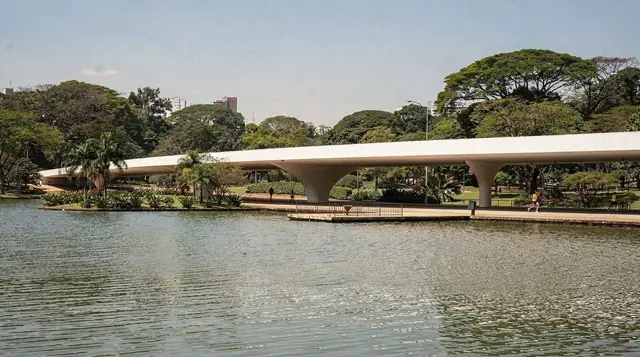
Every major city has a park that functions as its emotional centre, and in São Paulo that’s Ibirapuera. It’s not just green space — it’s a working piece of civic architecture, with several buildings designed by Oscar Niemeyer in the 1950s that still house three of the city’s best museums, wrapped around paths that tens of thousands of runners, cyclists and skaters use every single day. Few parks anywhere combine that level of daily civic use with that concentration of significant architecture, and it’s worth approaching Ibirapuera with both in mind rather than treating it as a simple green break between sightseeing stops.
| Where | Bordering Moema, Vila Mariana, Itaim Bibi and Indianópolis, southern zone |
| Cost | Free entry; individual museums charge R$10–20 |
| Time needed | 3–4 hours for a proper visit |
| Getting there | Metro Ana Rosa plus a short bus or walk, or rideshare direct |
| Best time | Weekend mornings, 7am–11am |
Niemeyer’s pavilions
The park’s Marquise — a long, sinuous concrete canopy stretching for several hundred metres — connects several exhibition pavilions that host rotating design, fashion and art shows, alongside the São Paulo Bienal, one of the world’s most important contemporary art biennials, held here every two years. Even without a specific exhibition on, the Marquise itself is worth seeing as a piece of mid-century Brazilian modernism. A private architecture tour that includes Ibirapuera alongside Centro Histórico’s Edifício Copan gives the fullest picture of Niemeyer’s São Paulo work in one outing.
MAM and the Afro Brasil museum
The Museu de Arte Moderna (MAM) sits just inside one of the park’s entrances and runs a strong, changing programme of Brazilian modern and contemporary art, generally less crowded and noticeably cheaper to enter than MASP on Paulista. On the park’s eastern side, the Museu Afro Brasil covers Afro-Brazilian history, art and culture across several centuries, one of the most substantial collections of its kind in the country and, despite that, still noticeably under-visited relative to its quality and scale — see the Museu Afro Brasil guide for what’s inside.
Running, cycling and the Sunday closure
On Sundays and public holidays, the internal roads close to cars entirely, and the park fills with runners, families on bikes, and rollerbladers using a route that loops roughly 4.5km around the perimeter, one of the most reliably busy stretches of recreational infrastructure anywhere in the city. Bike rental stands operate near several entrances. An Ibirapuera Park bike tour is a relaxed, low-effort way to cover the whole park’s landmarks in under two hours if walking all of it doesn’t appeal. More detail on the running culture is in running and cycling in São Paulo.
The Ayrton Senna monument
Near one of the park’s lakes stands a memorial to Ayrton Senna, Brazil’s most celebrated Formula 1 driver, who died in a crash at Imola in 1994 and remains a genuine national figure of mourning and pride decades later. An Ayrton Senna highlights tour connects this memorial with other Senna-related sites around the city for visitors with a specific interest in motorsport history.
Ibirapuera with kids
The park has playgrounds, a small lake with paddleboats, wide flat paths and generally clean, well-maintained public restrooms near the main entrances, all of which make it one of the easier family destinations in São Paulo — see São Paulo with kids for how it fits alongside the nearby Aquário de São Paulo.
The park’s design and history
Ibirapuera opened in 1954 as part of São Paulo’s 400th-anniversary celebrations, and the city commissioned Oscar Niemeyer, alongside landscape architect Roberto Burle Marx, to design it as a showcase of modern Brazilian ambition at a moment when the country was positioning itself as a rising industrial power. That context matters: the park was never meant as a simple green space but as a deliberate statement, which is part of why it carries so much architecture relative to its size compared with a typical city park elsewhere in the world. Burle Marx’s landscaping — winding paths, deliberately varied planting, artificial lakes — was itself influential across Brazilian landscape design for decades afterward.
The lakes and the Obelisco
Near the park’s northern entrance, a large obelisk commemorates the 1932 Constitutionalist Revolution, a short-lived armed uprising by São Paulo state against the federal government under Getúlio Vargas. It’s a slightly odd landmark to encounter in the middle of a park otherwise dedicated to leisure and culture, but it’s a useful reminder that São Paulo’s civic identity has always included a strong streak of regional pride and occasional friction with the rest of Brazil. The park’s artificial lake nearby is a popular spot for a slower walk away from the busier paths closer to the museums.
What to skip if you’re short on time
The Planetarium and the Japanese Pavilion, a gifted replica of a 16th-century Kyoto temple, are pleasant but skippable if you only have a couple of hours — prioritise MAM or the Afro Brasil museum instead, since they’re the stronger cultural draws. For how Ibirapuera compares to the city’s other green spaces, see the best parks in São Paulo, and for a photography-focused visit, the best photography spots in São Paulo.
Interlagos, a longer trip from the park
Motorsport fans occasionally combine an Ibirapuera visit with a detour to the Interlagos circuit, home of the Brazilian Grand Prix every November — it’s a separate trip across town, not walkable from the park, but the Brazilian Grand Prix at Interlagos guide has the full logistics if the timing lines up.
Frequently asked questions about visiting Ibirapuera
Is Ibirapuera Park free to visit?
Yes, entry to the park is free; only the individual museums inside charge admission, generally R$10–20 each.
How do I get to Ibirapuera Park without a car?
The nearest metro stations, Ana Rosa (Line 1 Blue) and AACD-Servidor (Line 5 Lilac), both require a short bus ride or 15–20 minute walk to reach the park entrances; a rideshare direct to your preferred gate is often simpler.
Is Ibirapuera Park safe?
Yes, it’s one of the safer public spaces in São Paulo, especially during the day and on busy weekend mornings; normal caution applies after dark, when it’s quieter.
How much time should I plan for Ibirapuera?
Three to four hours for a proper visit including at least one museum; you can see the highlights in under two hours if you’re pressed for time.
Is Ibirapuera good for kids?
Yes — playgrounds, a lake with paddleboats, wide flat paths and generally low traffic make it one of the more family-friendly destinations in the city.
What’s the best day to visit?
Sunday morning, when internal roads close to traffic and the park is at its liveliest, or any weekday morning if you’d prefer it quieter.
Are there restaurants inside the park?
A few kiosks and cafés operate near the main entrances, but options are limited; most visitors eat before or after in nearby Moema or Itaim Bibi, both a short ride away with a much wider range of restaurants.
Can I rent a bike inside the park?
Yes, bike rental stands operate near several entrances, typically charging by the hour, and it’s a popular way to cover the park’s full loop without the time commitment of walking it.
Is Ibirapuera Park open every day?
Yes, the park itself is open daily, though individual museums keep their own hours and most close on Mondays — check ahead if a specific museum is the priority for your visit.
How does Ibirapuera compare to Central Park in New York or Hyde Park in London?
It’s smaller than Central Park but carries a much higher density of significant architecture relative to its size, given Niemeyer’s pavilions and the three major museums packed into a relatively compact area — proportionally, it may be the single most culturally dense park of its kind anywhere in South America.
The Bienal, if your timing lines up
The São Paulo Bienal, held in even-numbered years, is one of the most significant recurring contemporary art events in the Southern Hemisphere, drawing international artists and curators to fill the Ciccillo Matarazzo Pavilion — the same Niemeyer-designed building used for other exhibitions in non-Bienal years. If your visit happens to coincide with it, it’s worth restructuring your day around a longer visit here rather than treating the park as a quick walk-through, since the exhibition alone can easily take two to three hours to see properly. Outside Bienal years, the pavilion still hosts smaller design and art shows worth checking before your visit.
Seasonal considerations for visiting Ibirapuera
Because Ibirapuera has limited shade across its central lawns, the park’s character shifts noticeably with São Paulo’s seasons. Between December and March, the combination of heat and the city’s characteristic late-afternoon thunderstorms makes early morning the only comfortable window for an extended visit — storms tend to arrive after 3 or 4pm, sometimes with little warning, so an afternoon picnic plan can end abruptly. Between April and August, cooler, drier weather makes the park pleasant for most of the day, and this is genuinely the best season for a long, unhurried visit. Whatever the season, bring water and sun protection if you’re planning to spend more than an hour or two outdoors, since shaded benches are less plentiful than the park’s overall size would suggest.
Fitting Ibirapuera into a longer trip
On a three-day itinerary, Ibirapuera works best as a Sunday morning activity paired with lunch in neighbouring Moema. On the art and architecture itinerary, it’s a core stop alongside Centro Histórico and the Pinacoteca, and it’s worth allowing a full half-day here rather than squeezing it between two other stops, given how much genuinely worthwhile content the park holds. Families should see the São Paulo with kids itinerary for how it slots into a four-day family trip, typically as a lower-intensity day sandwiched between busier sightseeing days elsewhere in the city.