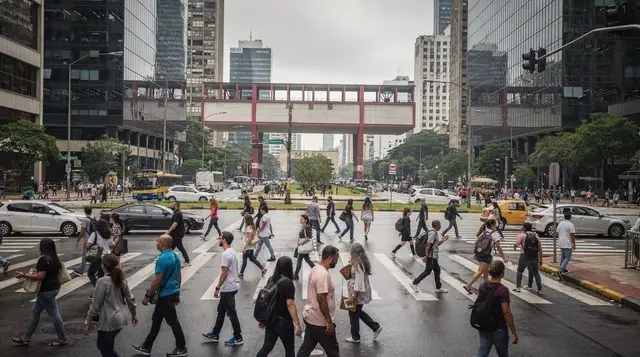
A guide to Avenida Paulista
How much time should I actually budget for Avenida Paulista, and in what order should I see it?
Three to five hours, walked from the Trianon-Masp end toward Consolação. Start with MASP, cross to Parque Trianon and Casa das Rosas, then finish at Sampa Sky near Consolação — that direction keeps the best photo light and avoids doubling back.
Most guides to Avenida Paulista tell you what’s on it. Fewer tell you in what order to see it, how long each stop genuinely needs, or which direction to walk so you’re not backtracking across six lanes of traffic. This is the practical route: a stop-by-stop plan for the avenue itself, plus what to do with the two hours on either side of it that most visitors waste in transit instead of in Jardins or Bela Vista, where the good food actually is. For the general overview — what the avenue is, when it closes to cars, quick facts — see the Avenida Paulista destination page; this guide assumes you already know that and want the walking plan.
| Where | 2.8km avenue, Praça Oswaldo Cruz to Praça Marechal Cordeiro de Farias |
| Cost | Free to walk; MASP entry around R$50 (about US$10), free on Tuesdays |
| Time needed | 3–5 hours for the full route below, including a museum stop |
| Getting there | Metro Line 2 Green: Consolação, Trianon-Masp, Brigadeiro or Paraíso |
| Best time | Sunday 7am–8pm (car-free); weekday mornings for a quieter MASP visit |
Start at Trianon-Masp station, not Consolação
Most visitors arrive at the wrong end. Consolação station drops you at the western tip of the avenue, near Sampa Sky and the shopping centres — fine as a finishing point, but it means you’ll be walking east into the afternoon sun and finishing your day at MASP just as the queues peak. Instead, take Line 2 Green to Trianon-Masp station, which puts you directly beneath the museum. This gives you the whole rest of the avenue to walk with the light behind you and saves the crowded stretch for last, when you’re ready to be done anyway.
Stop one: MASP, first thing
Go straight to MASP before the rest of the avenue wakes up — weekday mornings before 11am are noticeably calmer than afternoons. The concrete-and-glass building raised on red pillars holds the largest Western art collection in the Southern Hemisphere, displayed on distinctive glass easels rather than walls. Entry runs around R$50, free on Tuesdays, though Tuesday’s crowds usually cancel out the savings unless you arrive right at opening. A skip-the-line MASP tour is worth the premium specifically on a Tuesday, or if your schedule only allows an afternoon visit.
Stop two: cross to Parque Trianon
Directly opposite MASP, Parque Trianon is a preserved fragment of the Atlantic Forest that once covered this entire plateau before the city existed — genuinely shaded, genuinely quiet, a strange contrast against the concrete on either side. Fifteen to twenty minutes here resets you for the rest of the walk. A guided highlights walk of the avenue typically threads through here, which is a reasonable option if you’d rather have context along the way than navigate alone.
Stop three: Casa das Rosas, the one building most people miss
A short walk toward Paraíso station, Casa das Rosas is a 1930s Beaux-Arts mansion — one of the only buildings on the avenue that predates the skyscraper boom — now a free public poetry and literature centre with small rotating exhibitions. It’s dwarfed by the towers around it and easy to walk straight past; look for the low white building set back from the street with a garden in front. Twenty minutes here is enough, and it’s one of the few genuinely uncrowded stops on the whole route.
Stop four: Japan House, if design interests you
A few blocks further toward Consolação, Japan House runs free rotating exhibitions on Japanese architecture, craft and design, funded by the Japanese government as a cultural outreach centre. It’s a reliable indoor option if the weather turns, and unlike most of the avenue’s other buildings, you can actually go inside.
Stop five: Sampa Sky, saved for the end
Near Consolação station, inside Shopping Cidade São Paulo, Sampa Sky is a rooftop glass observation platform with 360-degree views — newer and generally less crowded than the older Farol Santander deck downtown. Finishing your walk here works well because it gives you a wide-angle view back over everywhere you just walked. Sampa Sky entry tickets are cheaper than most comparable viewpoints in the city. Full logistics are in the Sampa Sky guide.
How the avenue got its current shape
Avenida Paulista opened in 1891, laid out along a ridge that coffee barons chose specifically because it sat above the smoke and flooding of the city below — for decades it was lined with lavish private mansions, almost none of which survive today. The transformation into the corporate, high-rise avenue you see now happened fast, mostly from the 1950s through the 1970s, as families sold up and developers replaced the mansions with office towers and banks. MASP itself, completed in 1968 and daringly suspended above an open public plaza on massive red pillars, was a deliberate architectural statement against that same wave of conventional tower development — which is part of why it still reads as strange and radical even now, decades later. Knowing this history changes how you look at the avenue: almost nothing you’re walking past is older than about seventy years, on a street that’s routinely described as the symbolic heart of the city.
Paulista as protest ground
Beyond museums and shopping, Avenida Paulista is São Paulo’s default stage for large-scale public demonstrations — political rallies, LGBTQ+ Pride (one of the largest Pride parades in the world), and New Year’s Eve, when the city closes the avenue for a major fireworks display and free concert. If your visit coincides with any of these, expect road closures well beyond the usual Sunday pattern and plan your walking route accordingly; check what’s scheduled before you go; a genuine mass event changes the character of the avenue completely, in ways that go well beyond the calmer weekly car-free Sunday described above. See New Year’s Eve in São Paulo and LGBTQ+ São Paulo for what these look like in practice.
If you don’t want to walk the whole route
The full stop-by-stop plan above is designed for walking, but Line 2 Green runs directly beneath the avenue with stations roughly every 800m to 1km — Trianon-Masp, Consolação, Brigadeiro and Paraíso — so it’s entirely reasonable to skip a stretch by metro if you’re short on time or the heat is intense. A one-stop hop between Trianon-Masp and Consolação takes about three minutes and saves a 15–20 minute walk, which matters more than it sounds like on a hot weekday afternoon with a museum visit still ahead of you.
Sunday changes the plan entirely
Every Sunday from roughly 7am to 8pm, the avenue closes to vehicle traffic completely, and the walking route above still works but the character of the street changes — cyclists, skateboarders, street food vendors and pop-up stalls take over all six lanes. If your visit falls on a Sunday, add an hour to the plan above just for people-watching, and expect MASP’s surrounding plaza to be one of the busiest points on the entire route by midday. More detail on what a Sunday here actually looks like is in Avenida Paulista on a car-free Sunday.
The corporate towers, briefly
Most of the avenue’s skyline is unremarkable bank and insurance-company architecture from the 1960s through the 1990s, but a handful of buildings stand out enough to look up for. The FIESP headquarters building, closer to the Consolação end, is one of the avenue’s more distinctive brutalist structures and occasionally opens its rooftop or cultural spaces for public events — worth a glance at what’s scheduled if architecture interests you. None of this needs a dedicated stop on the route above; it’s more a case of looking up rather than straight ahead as you walk between the main attractions.
Budgeting the walk
A realistic per-person budget for the full route: R$50 for MASP (or free if you time a Tuesday well), R$30–40 for Sampa Sky, and R$20–40 for a coffee or snack break along the way — call it R$100–130 (roughly US$20–26) if you do both paid attractions, or under R$50 if you stick to the free stops (Trianon, Casa das Rosas, Japan House) and skip one of the two paid viewpoints. Given that MASP and Sampa Sky cover genuinely different things — art collection versus city view — most visitors find both worth the combined cost, but if you’re tight on budget or time, MASP is the one to prioritise.
Where to actually eat
This is the part most avenue guides get wrong: eating on Paulista itself is a mistake. The restaurants and cafés directly on the avenue are almost entirely aimed at office workers on a lunch break — forgettable chain food at inflated prices. Walk one block north into Jardins, or one block south into Bela Vista, and the quality jumps immediately. Bela Vista in particular has a strong concentration of casual Italian-Brazilian cantinas that are a genuinely better use of a meal than anything you’ll find on the avenue itself. See the guide to Bixiga, which borders Bela Vista, for specific recommendations.
Avenida Paulista versus Rua Oscar Freire, Jardins
Visitors often ask which “shopping street” to prioritise if time is short — they’re not the same kind of street at all.
| Avenida Paulista | Rua Oscar Freire (Jardins) | |
|---|---|---|
| Character | Corporate, cultural, civic | Boutique, luxury retail |
| Best for | Museums, Sunday street life | High-end shopping, people-watching |
| Typical visit length | 3–5 hours | 1–2 hours |
| Food nearby | Mostly skip; walk one block off | Genuinely good, on the street itself |
Full detail on Jardins is in the guide to Jardins, which borders Paulista directly to the north.
Accessibility along the avenue
Avenida Paulista is one of the more accessible walking routes in São Paulo, largely because it’s flat, wide and paved throughout its 2.8km length, with no steep grades or uneven historic cobblestone sections like parts of Centro Histórico. Metro Line 2 Green’s stations along the avenue — Trianon-Masp, Consolação, Brigadeiro and Paraíso — all have lift access, and MASP itself, raised on its distinctive pillars, has step-free access to the main gallery levels via lift from the ground-floor plaza. Parque Trianon’s paths are mostly flat and well maintained, though a few side trails dip into the preserved forest terrain and aren’t fully step-free. Sampa Sky, inside a modern shopping centre, is fully accessible by lift from street level. If you’re planning this route with a wheelchair or mobility aid, it’s genuinely one of the easier full-day walking plans on this site to execute without modification.
Doing this walk solo
Avenida Paulista is a comfortable solo walk by day, arguably one of the most straightforward solo activities in the city — it’s busy with office workers and visitors throughout normal hours, well signposted, and doesn’t require navigating quiet side streets the way some neighbourhood walks do. MASP and Sampa Sky both work fine as solo visits with no reservation hurdles beyond standard ticketing, and Parque Trianon and Casa das Rosas are calm enough for a solo break without feeling isolated.
The one time to be more deliberate is a Sunday car-free session, when the avenue’s crowds swell significantly — keep valuables secured in the denser stretches near Trianon-Masp, standard advice for any crowded public space rather than something specific to this street. After dark, once the office crowd has thinned and shops have closed, the avenue is quieter and less lively than during the day; it’s not unsafe, but there’s little reason to plan an evening solo walk here when the daytime version is so much more rewarding.
Timing the walk around the seasons
São Paulo’s seasons change this walk more than you might expect from an urban avenue. In summer (December-March), the exposed stretches between Trianon-Masp and Consolação get genuinely hot with little shade beyond Parque Trianon itself, and the afternoon storms typical of this season can arrive with little warning — an early start beats the heat and the storm risk in the same move. Winter (June-August) is the most comfortable season for the walk: cooler, drier, with essentially no rain risk, though mornings can be crisp enough to want a light jacket before the day warms up. Spring (September-November) brings the ipê trees around Parque Trianon into bloom, a genuinely pretty seasonal detail worth timing a visit around if flowering trees interest you, though the rains typical of this season are picking back up by late spring. Whichever season you visit in, the Sunday car-free schedule runs year-round, so that part of the plan doesn’t need seasonal adjustment.
Frequently asked questions about walking Avenida Paulista
What’s the best order to walk Avenida Paulista in?
Start at Trianon-Masp station, do MASP first, then Parque Trianon, Casa das Rosas, Japan House, and finish at Sampa Sky near Consolação. This avoids backtracking and saves the busiest stop, MASP, for the morning.
How long does the whole avenue take to walk end to end?
About 45 minutes without stopping, but the route above with stops takes three to five hours, and that’s the version worth doing.
Is it worth doing this walk on a weekday if I can’t make it on Sunday?
Yes — MASP, Casa das Rosas and Japan House all operate normally on weekdays, and you’ll actually have an easier time getting into MASP. You’ll just miss the car-free street life.
Where should I eat along this route?
Not on the avenue itself. Detour one block into Jardins to the north or Bela Vista to the south for anything worth remembering.
Is Avenida Paulista walkable in the rain?
Most of the route has covered stretches or nearby indoor fallbacks — MASP, Japan House and the shopping centres near Consolação all work. See what to do in São Paulo when it rains for a fuller rainy-day plan.
Can I do this walk with kids?
Yes — it’s flat, well paved, and Parque Trianon in particular is a good rest stop. MASP’s collection may be a harder sell for younger children than the outdoor stretches of the route.
Do I need a full day for Avenida Paulista and Jardins together?
Not necessarily a full day, but plan for most of one. Finishing the avenue walk by early afternoon leaves a solid few hours for Rua Oscar Freire and the rest of Jardins before dinner.
What was here before the office towers?
Coffee-baron mansions, almost none of which survive — the avenue was rebuilt into its current corporate form mostly between the 1950s and 1970s, which is why so little pre-war architecture remains along the route.
Fitting this walk into a longer trip
This route is the natural backbone of a one-day São Paulo itinerary’s afternoon block, usually following a morning in Centro Histórico. On a three-day itinerary, try to schedule this walk for whichever day falls on a Sunday, since the car-free avenue is genuinely one of the best free experiences in the city. For architecture-focused travellers, the art and architecture itinerary extends this route with a deeper look at MASP’s collection and the modernist buildings nearby.
São Paulo neighborhood tours on GetYourGuide
Verified deep-linked GetYourGuide tours. Book through these links and we earn a small commission at no cost to you.
These are our own photographs of São Paulo, not the operator's pictures of this tour — open the tour page to see those.