Afro-Brazilian São Paulo
What's the best way to experience Afro-Brazilian culture and history in São Paulo?
Start with the Museu Afro Brasil in Ibirapuera Park, the city's most serious collection of Afro-Brazilian art and history, then build outward to a Vai-Vai samba rehearsal in Bixiga, a capoeira roda in one of the city's parks, and the hip-hop and spoken-word scenes rooted in the southern periphery. None of this is packaged as a single tourist circuit, so plan it as a thread through a few different days rather than one outing.
São Paulo’s official self-image runs through coffee barons, Italian cantinas, and glass towers on Avenida Paulista, and that story is true as far as it goes — but it leaves out the population that built the city’s wealth in the first place and then, deliberately, was pushed out of the labour market that replaced it. Brazil abolished slavery in 1888, later than any other country in the Americas, and São Paulo’s coffee elite responded by importing European immigrants rather than hiring the newly freed Black paulistanos who had done the same work unpaid for generations.
That decision, driven by an explicit “whitening” ideology fashionable among the era’s elite, shaped where Black São Paulo settled, what work it could get, and how invisible it remained in the city’s official narrative for most of the 20th century. None of that history stayed buried — it surfaces today in a serious museum, a legendary samba school, a hip-hop scene that reshaped Brazilian music, and neighbourhoods most guidebooks skip entirely.
| Essential stop | Museu Afro Brasil, Pavilhão Padre Manoel da Nóbrega, Ibirapuera Park |
| Cost | Museu Afro Brasil is free on Saturdays; R$6–20 other days (about US$1–4) |
| Time needed | Half a day for the museum and park; a full evening if you add a Vai-Vai rehearsal |
| Getting there | Metro Ibirapuera/AACD (Line 5 Lilac) or a short taxi from Vila Mariana |
| Best time | Weekday mornings for the museum; Sunday evenings for samba rehearsals |
Whitening policy and the labour market Black paulistanos were shut out of
The period right after abolition is the hinge point for almost everything else in this guide. Coffee planters and city elites, worried that a free Black workforce would demand wages and conditions, actively subsidized European immigration instead — a policy historians call branqueamento, whitening, that was openly discussed in the press and government of the era as a way to remake Brazil’s population and workforce in a European image.
The practical result was that Italian, and later Japanese and other immigrant labourers, filled the coffee-farm jobs and the factory floors that opened up in the following decades, while formerly enslaved Black paulistanos and their descendants were largely pushed into informal work, domestic service, and the city’s poorer, less-connected districts. This is the uncomfortable backstory behind the fact that São Paulo’s immigrant neighbourhoods — Bixiga, Liberdade, Bom Retiro — get so much more attention in the standard telling of the city’s story than its Black communities do, even though Black paulistanos and enslaved labour built the wealth that made those waves of immigration possible in the first place.
Museu Afro Brasil, the city’s essential stop
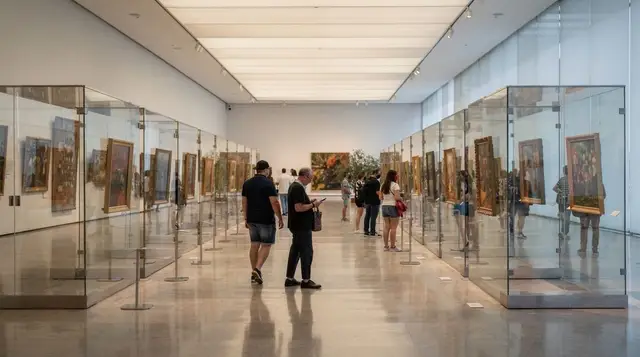
The Museu Afro Brasil sits inside Ibirapuera Park, in the Pavilhão Padre Manoel da Nóbrega, a building designed by Oscar Niemeyer as part of the same 1950s park complex that houses the Bienal pavilion and the Oca. Founded in 2004 and curated by the sculptor and art historian Emanoel Araujo, it holds one of the largest collections of Afro-Brazilian art, artefacts, and historical documentation in Latin America — paintings, sculpture, religious objects tied to Candomblé and Umbanda, and an unflinching section on the transatlantic slave trade and Brazilian slavery itself, presented with a directness that’s rare in Brazilian museums. Entry is free on Saturdays and low-cost the rest of the week, and it easily justifies two to three hours. Pair it with a walk through the wider Ibirapuera park, or fold it into a broader Ibirapuera park guide day that also covers the Bienal and Oca pavilions.
MASP downtown, on Avenida Paulista, is the other major museum with real relevance here: its 2018 exhibition Histórias Afro-Atlânticas (Afro-Atlantic Histories) was one of the most acclaimed shows in the museum’s recent history and permanently shifted how much space Afro-Brazilian and Afro-Atlantic art gets in the collection and rotating exhibitions since. A guided tour of MASP’s main collection is worth booking specifically if this angle interests you, since a guide can point out which works in the permanent hang connect directly to this history — it’s easy to walk past otherwise. Full practical details on the museum itself are in the MASP guide.
Vai-Vai, Bixiga, and a history hiding under an Italian postcard
Bixiga is marketed almost entirely as São Paulo’s Italian immigrant quarter, and that’s accurate for the cantina culture that dominates the neighbourhood today — but the area’s most decorated cultural institution has a different origin story. Vai-Vai, one of São Paulo’s most successful samba schools with multiple Carnival championships, was founded in 1930 by Black street sweepers and manual labourers who lived and worked in the neighbourhood before the heaviest wave of Italian settlement fully took hold.
The school’s name and identity are inseparable from Bixiga’s Black working-class roots, a layer of the neighbourhood’s history that the cantina-and-pizza narrative usually skips entirely. Some samba schools, including Vai-Vai, open rehearsal nights to visitors on a paid or donation basis outside Carnival season — check current schedules locally rather than assuming, since they shift year to year. The full Bixiga guide covers the neighbourhood’s Italian side; this is the half of the story it’s easy to miss.
Capoeira, still practised in the city’s parks
Capoeira — the Afro-Brazilian martial art and dance form developed by enslaved and formerly enslaved communities, disguising combat training as rhythmic play — has a genuine, ongoing practice scene in São Paulo, not just a tourist demonstration circuit. Academies teaching both Capoeira Angola (the slower, more traditional style) and Capoeira Regional (faster, more acrobatic) operate across the city, and informal rodas — circles where practitioners play to berimbau and drum accompaniment — turn up in parks on weekends, Ibirapuera among them. It’s worth asking at your accommodation or checking listings for a scheduled roda rather than hoping to stumble on one, since they’re not fixed to a single daily spot the way the Liberdade fair is. Watching, or in some cases joining a beginner class, is one of the more physical, participatory ways into this history, distinct from a museum visit.
Samba’s São Paulo roots, separate from Rio’s
São Paulo’s samba scene developed on a parallel track to Rio’s more internationally famous version, rooted in Bantu-derived musical traditions carried by enslaved and freed Black communities and later reinforced by internal migration from Bahia and Minas Gerais into São Paulo’s periphery through the 20th century. The city’s samba schools — Vai-Vai, Camisa Verde e Branco, Mocidade Alegre, Nenê de Vila Matilde among them — compete in their own Carnival parade, smaller and far less internationally covered than Rio’s Sambadrome spectacle but every bit as serious to the communities that run them.
A Carnival parade seating package is the most reliable way to see a São Paulo samba school perform at full scale if your visit lines up with Carnival season (February or March). Outside Carnival, the wider guide to where to hear samba in São Paulo covers rehearsal nights and live venues year-round, and São Paulo’s live music guide has the broader picture of where Black-rooted genres — samba, but also funk and MPB — show up on stages across the city.
The periphery, hip-hop, and a literary scene most visitors never hear about
The story doesn’t stop with samba. In the 1980s, downtown São Paulo’s São Bento metro station became an unlikely epicentre for the city’s emerging hip-hop scene — b-boys, DJs, and rappers gathering weekly in a way that eventually produced Racionais MC’s, arguably Brazil’s most important rap group, whose lyrics about police violence, racism, and life in the southern periphery reshaped Brazilian popular music’s willingness to talk about race directly. That periphery — the vast, underserved southern and eastern zones far from the postcard neighbourhoods most visitors see — remains the creative centre of contemporary Black paulistano culture.
The Sarau da Cooperifa, a long-running weekly poetry and spoken-word night in Campo Limpo in the city’s Zona Sul, is one of the best-known examples: a genuinely community-run literary movement, not a staged cultural product, that’s given a platform to Black writers largely ignored by São Paulo’s traditional literary establishment. Neither of these scenes is set up for casual tourism, and that’s part of what makes them real — approach with a local contact or a specialized guide rather than showing up cold.
Food: feijoada, Bahian kitchens, and what’s actually on the menu
Feijoada, the black-bean-and-pork stew now treated as Brazil’s national dish, has documented roots in the improvised cooking of enslaved communities, who made use of cheaper cuts of meat alongside beans — though the full story is debated among historians, and the modern restaurant version is a long way from its origins. It’s worth reading the feijoada guide for where to eat it properly rather than at a tourist-priced hotel buffet. Beyond feijoada, São Paulo’s substantial community with roots in Bahia has brought genuine Afro-Bahian cooking to the city — moqueca (a coconut-and-palm-oil fish stew) and acarajé (black-eyed-pea fritters, street food with clear West African lineage) turn up at Bahian-run restaurants and stalls scattered through the city rather than concentrated in one neighbourhood, so it’s worth asking locally rather than expecting a single “Bahian quarter.”
Contemporary art and the street-art connection
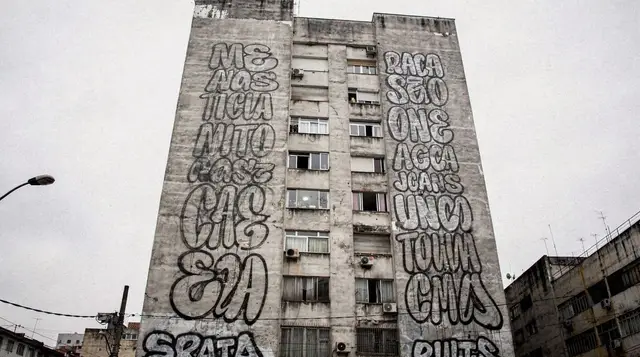
São Paulo’s street-art scene, one of the largest and most internationally recognized in the world, has a real Black-artist lineage running through it alongside its better-known pixação and graffiti traditions — muralists working in neighbourhoods across the city increasingly address Black identity, police violence, and periphery life directly in large-scale public work, extending the same themes found in Racionais MC’s lyrics and the Sarau da Cooperifa into visual form.
A guided tour focused on Afro-Brazilian culture and street art is the most direct way to see this angle of the scene with context, rather than walking past murals without knowing what they’re responding to. It pairs well with the broader São Paulo street art guide and guide to the city’s leading street artists, and for the wider mural circuit itself, a general street art and graffiti tour covers more ground across multiple neighbourhoods in a single outing. The São Paulo Bienal, held in Ibirapuera Park a short walk from the Museu Afro Brasil, has also featured a growing number of Afro-Brazilian and Afro-diasporic artists in recent editions — worth checking the current programme via the Bienal guide if your visit lines up with an active edition.
Religious and cultural institutions beyond the museum
Afro-Brazilian religious traditions — Candomblé and Umbanda, both syncretic faiths blending West and Central African cosmologies with Catholic imagery — have a real, functioning presence in São Paulo, mostly through terreiros (temple communities) spread across the city rather than concentrated in one district. These are active places of worship, not tourist attractions, and visiting respectfully means going through a personal introduction or a specialized cultural guide rather than showing up as a spectator.
The Museu Afro Brasil’s own collection includes a substantial section of religious objects and iconography tied to these traditions, presented with real scholarly context, which makes it the most accessible and appropriate way for a visitor to engage with this layer of the culture without intruding on an active terreiro. Community cultural centres tied to specific neighbourhoods — several operating out of the city’s southern periphery — run capoeira classes, drumming circles, and youth arts programmes that occasionally welcome visitors for a fee or donation; these tend to circulate by word of mouth rather than fixed listings, so ask locally or through a guide who works specifically in this space.
Three starting points, compared
| Museu Afro Brasil | Vai-Vai rehearsal | Sarau da Cooperifa | |
|---|---|---|---|
| Format | Museum and permanent collection | Live samba-school rehearsal | Weekly spoken-word night |
| Where | Ibirapuera Park | Bixiga | Campo Limpo, Zona Sul |
| Best for | History, art, context | Music, community energy | Contemporary voices, literature |
| Advance planning needed | Low — open regular hours | Medium — confirm schedule locally | High — go with a local contact |
Frequently asked questions about Afro-Brazilian culture in São Paulo
Is the Museu Afro Brasil worth visiting if I only have one day in São Paulo?
Yes, if this history interests you at all — it’s inside Ibirapuera Park, so it combines easily with the Bienal pavilion, the Oca, and a walk through the park itself, without requiring a separate half-day.
Can tourists attend a Vai-Vai samba school rehearsal?
Often yes, on a paid or donation basis outside Carnival season, but schedules vary by year and season — confirm locally through your accommodation or the school directly rather than assuming a fixed weekly night.
Where can I see a capoeira roda in São Paulo?
Parks including Ibirapuera host informal weekend rodas, but timing isn’t fixed to a daily schedule — check local listings, or ask a capoeira academy about visiting a class if you want a guaranteed session.
Is São Paulo’s samba scene as accessible to visitors as Rio’s?
It’s smaller and less set up for tourism, but genuinely accessible if you seek it out — the samba in São Paulo guide covers specific venues and rehearsal nights year-round.
What’s the connection between Bixiga and Afro-Brazilian culture, given it’s known as an Italian neighbourhood?
Vai-Vai, one of the city’s most prestigious samba schools, was founded there in 1930 by Black working-class residents before the area became as strongly associated with Italian immigration as it is today — both histories are real and coexist in the same few blocks.
Is it safe and appropriate to visit the periphery neighbourhoods connected to São Paulo’s hip-hop and literary scenes?
These are lived-in, working residential areas, not tourist zones, and they’re best approached with a local contact, a specialized tour, or careful advance research rather than a spontaneous visit — treat it the same way you would any unfamiliar residential district in a large city.
Are there restaurants specializing in Afro-Bahian food in São Paulo?
Yes, though they’re scattered across the city rather than concentrated in one district — ask locally for current recommendations, since this is a smaller, more dispersed scene than the city’s larger dedicated food quarters.
Fitting this into your trip
On a three-day itinerary, the Museu Afro Brasil fits naturally into an Ibirapuera Park morning alongside the Bienal pavilion. A five-day itinerary has room to add a Vai-Vai rehearsal night in Bixiga if the timing lines up, and a full seven-day itinerary is really the minimum if you want to reach the periphery scenes — the Sarau da Cooperifa and the hip-hop history around São Bento — with any depth. For the wider historical frame this all sits inside, read a short history of São Paulo first.
São Paulo culture tours on GetYourGuide
Verified deep-linked GetYourGuide tours. Book through these links and we earn a small commission at no cost to you.
These are our own photographs of São Paulo, not the operator's pictures of this tour — open the tour page to see those.