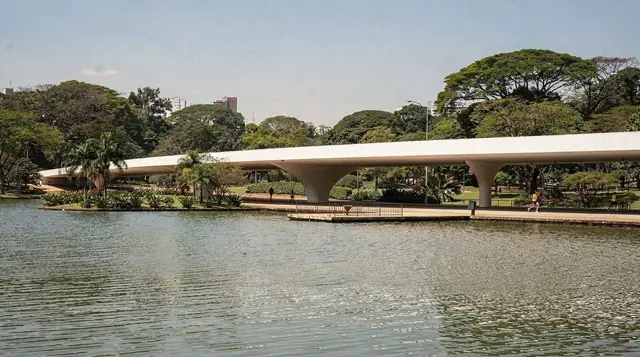
Parque Villa-Lobos
What is Parque Villa-Lobos and is it worth visiting?
It's a large, flat riverside park in São Paulo's west zone, built for cycling, running and picnicking rather than sightseeing — its size, wide paved paths and Sunday car-free road make it the city's most popular park for exercise. It's worth an hour or two if you want to see how paulistanos actually spend a free morning, though it doesn't have the museums or landmark draws of Ibirapuera.
Parque Villa-Lobos doesn’t get the tourist attention that Ibirapuera does, and that’s mostly fair — it has no museums, no big lake, no obelisk. What it has instead is scale: 726,000 square metres of flat, open riverside land along the Pinheiros river in the western Alto de Pinheiros and Real Parque area, with paved loops long enough that serious runners and cyclists treat it as a training ground rather than a stroll. If Ibirapuera is São Paulo’s park for culture, Villa-Lobos is its park for exercise, and on any given weekend morning it’s full of people proving it.
The park opened in 1982 on land that once belonged to a textile mill, and it was named for Heitor Villa-Lobos, Brazil’s best-known classical composer — a fitting choice for a green space built more around movement and open air than around monuments. Two amphitheatres, a skate park, a children’s play area and a small planetarium round out the facilities, but the main draw for most visitors, local and foreign alike, is simply the space itself: room to move in a city that rarely offers it.
| Where | Alto de Pinheiros / Real Parque, west zone, along the Pinheiros river |
| Cost | Free entry |
| Time needed | 1–3 hours, depending on whether you’re exercising or just walking through |
| Getting there | Metro Line 4 (Yellow) to Vila Sônia, then bus or rideshare; car or rideshare more direct from most hotel areas |
| Best time | Weekday mornings for quiet paths; Sunday for the car-free Anel Viário road loop |
What’s actually inside the park
The park’s paved paths form a series of loops around open lawns, with the longest full circuit running close to 4.5 km — long enough that regulars do multiple laps rather than one pass through. Shade is inconsistent; large sections are open lawn rather than tree cover, which matters if you’re visiting midday in summer heat. The skate park near the Marginal Pinheiros side draws a genuinely skilled local crowd on weekends, worth a few minutes even if you’re not skating yourself. A children’s playground and a small planetarium (Planetário Ibirapuera’s counterpart, run by the city) sit toward the park’s northern end, though the planetarium keeps limited hours and isn’t the reason most people come.
Unlike Ibirapuera, Villa-Lobos has no lake and no major museum complex, which is the honest reason it doesn’t appear on as many “must-see” lists. What it does have is space that doesn’t feel hemmed in by traffic on every side — a rarer commodity in São Paulo than the park’s low profile suggests.
Running, cycling and the Sunday road closure
Villa-Lobos is where a large share of São Paulo’s running and cycling culture actually happens. The internal paths are flat, wide and mostly free of the pedestrian crush that clogs Ibirapuera’s narrower loop on weekend afternoons, which makes it the more comfortable option for anyone training seriously rather than just walking. On Sundays, the Avenida Professor Fonseca Rodrigues stretch alongside the park closes to cars as part of the city’s broader open-streets programme, adding a further loop of car-free road to whatever distance the internal park paths already offer — a genuinely good option if you’re staying nearby and want a long run or ride without dodging traffic.
Bike rental isn’t formally set up inside the park the way it is at Ibirapuera, so bringing your own bike, using a bike-share app, or renting from a shop near the entrance is the more realistic plan. If organised cycling with a guide is more your speed, the Ibirapuera Park bike tour covers the city’s other major park and includes a bike, which solves the rental question entirely — it’s a reasonable substitute if you’d rather not sort out logistics on your own. For the fuller comparison of how São Paulo’s green spaces stack up against each other, see the best parks in São Paulo.
Villa-Lobos versus São Paulo’s other big parks
| Parque Villa-Lobos | Parque Ibirapuera | Cantareira State Park | |
|---|---|---|---|
| Terrain | Flat, riverside, open lawns | Flat, manicured, landscaped | Real forest, trails, elevation |
| Best for | Running, cycling, Sunday road closure | Museums, people-watching, central location | Hiking, nature immersion |
| Getting there | West zone, car or rideshare more practical | Central, metro Line 2 or bus | Northern edge, car or guided tour |
| Time needed | 1–3 hours | 2–4 hours | Half day to full day |
If genuine forest hiking rather than a flat park loop is what you’re after, Cantareira State Park is the better fit, and the guided Cantareira hiking day trip includes transport, which solves the park’s biggest logistical hurdle. For a fuller look at hiking options further out, see hiking near São Paulo.
Getting there without a car
Villa-Lobos sits in a part of the west zone that isn’t directly on a metro line, which is the park’s main practical drawback for visitors without a car. The nearest station, Vila Sônia on Line 4 (Yellow), still requires a bus connection or a 15–20 minute rideshare from the station to reach the park entrance. From most central hotel areas — Paulista, Jardins, Centro — a rideshare takes roughly 20–35 minutes off-peak, worse during morning rush (7am–10am) or evening rush (5pm–8pm) when the Marginal Pinheiros expressway that runs alongside the park backs up badly. Weekend mornings are generally the easiest time to get there by car, before the afternoon crowds and before any weekend traffic builds on the Marginal.
Picnics, food and what to bring
There are a handful of small kiosks and food carts inside the park, mostly selling drinks, coconut water and light snacks rather than full meals, so bringing your own picnic is the more reliable plan if you want to sit down and eat properly. Shade is limited outside a few tree-lined sections, so sun protection matters more here than in a denser park like Ibirapuera. Water, sunscreen and comfortable shoes cover most of what you’ll need for a visit; if you’re planning to run or cycle a real distance, treat it like exercise anywhere else in São Paulo’s heat and humidity and pace accordingly.
A brief history of the site
Before it was a park, the land belonged to Companhia Nacional de Estamparia, a textile mill that operated on the site for decades before the city expropriated the area in the late 1970s. Traces of that industrial past are mostly gone now, absorbed into open lawn and paved paths, though the transformation itself says something about how São Paulo’s green spaces came to exist in the first place — carved out of former industrial or agricultural land rather than preserved from an original natural state, the way a park in an older European city might be. The park formally opened in 1994 after a long, staged development, later than its 1982 founding date might suggest, and it’s grown into its current role gradually rather than by original design: the running and cycling culture that now defines it developed organically as São Paulo’s fitness scene expanded through the 2000s and 2010s, not because the park was purpose-built for it from day one.
Weekday quiet versus weekend crowds
The gap between a weekday and a weekend visit to Villa-Lobos is bigger than at most São Paulo parks. On a Tuesday or Wednesday morning, the paths are sparsely used — a handful of retirees walking, a few remote workers taking a break, joggers with the space largely to themselves. By Saturday afternoon and especially Sunday, the same paths fill with families, group fitness classes, cyclists in full kit doing serious training loops, and food carts doing steady business near the main entrances. Neither version is wrong, but they’re different experiences: go on a weekday if you want a peaceful walk, go on a weekend — specifically Sunday morning, before midday heat sets in — if you want to see the park at its liveliest and make use of the car-free road loop alongside it.
Nearby neighbourhoods worth combining with a visit
Villa-Lobos sits close enough to Pinheiros and the broader Butantã district that a park visit pairs naturally with a longer afternoon in the area rather than standing alone as an isolated stop. Pinheiros in particular has a strong concentration of the kind of casual restaurants and bars that make sense after a run or a long walk, and it’s a short rideshare or a moderate walk from the park’s northern entrances. Butantã, better known for the Instituto Butantan snake and serum research institute, is a reasonable add-on for visitors with a specific interest in that kind of attraction, though it’s a separate stop rather than a natural extension of a park walk.
Photography and quiet corners
Villa-Lobos isn’t a conventionally photogenic park in the way a landscaped botanical garden is, but the river-adjacent paths at the western edge, away from the busiest central lawns, offer some of the more peaceful, uncluttered views in the park — worth seeking out if you’re carrying a camera and want something other than crowds and skate ramps in frame. Early morning light, before the heat and the crowds both build, tends to give the best results, particularly along the sections nearest the Pinheiros river where the open sky isn’t broken up by surrounding buildings the way it is toward the park’s eastern, more urban edges.
Accessibility
The main paths are paved and flat, which makes Villa-Lobos one of the more genuinely accessible parks in the city for wheelchair users, strollers or anyone with mobility limitations — a contrast with a place like Cantareira, where uneven forest terrain rules that out entirely. Surfaces are generally well maintained, though some sections nearer the river can get uneven or muddy after heavy rain, part of the reason the dry season (roughly April to September) tends to offer the more reliable underfoot conditions discussed in the best time to visit guide.
Cost and what to budget
Entry itself is free, which makes Villa-Lobos one of the more reliable stops for anyone piecing together a lower-cost day — see free things to do in São Paulo for other no-cost options that combine well with a park morning. Realistic spending inside the park is limited to snacks and drinks from the kiosks, typically R$8–20 (US$1.50–4) for coconut water or a light bite, plus whatever a rideshare there and back costs given the park’s distance from the metro network. For a broader sense of what a day in the city runs, see the São Paulo budget guide.
Events and the amphitheatres
The park’s two amphitheatres occasionally host free public concerts, community events and cultural programming organised by the city, though the schedule is irregular and not something to plan a visit around specifically — check local listings closer to your trip if live events are a draw. Outside scheduled programming, the amphitheatres mostly sit empty, used informally by skaters, small groups practising dance or capoeira, or anyone looking for a shaded spot with somewhere to sit that isn’t open lawn.
Seasonal variations: storms and the Pinheiros river
Villa-Lobos sits directly alongside the Pinheiros river, which makes it more exposed to summer’s storm pattern than a park set further from a waterway. During the December-March wet season, heavy afternoon downpours can leave sections of the riverside paths temporarily waterlogged, and the park occasionally closes specific low-lying areas for a few hours after the heaviest storms as a precaution — worth checking conditions before a summer visit if rain is in the forecast, since the flat, open terrain that makes the park pleasant on a dry day drains less predictably than a forest trail with more natural absorption.
The dry season, April through September, is more reliably firm underfoot across the whole park and is generally the better window for anyone planning a longer run or cycling session rather than a short visit. If genuine forest terrain with better natural drainage is more your interest than a flat riverside park, the guided Cantareira rainforest hike holds up better across both seasons, given its elevation and denser tree cover.
A stroller-friendly morning loop for families
For families with a stroller or young kids on foot, the park’s flat, wide paved paths make a genuinely manageable outing without needing to plan a specific route in advance — enter from one of the main gates along Avenida Professor Fonseca Rodrigues, take the outer loop at a relaxed pace, and use the playground near the park’s northern section as a natural turnaround point rather than attempting the full 4.5km circuit. A weekday morning, before 10am, avoids both the heat and the weekend crowds, and gives the easiest stroller conditions of the week, since paths aren’t sharing space with as many cyclists and runners moving at speed. Bring your own snacks and water rather than relying on the kiosks, which sell mostly drinks and light bites rather than anything substantial enough for a hungry toddler. This kind of low-key park morning pairs well as a gentler alternative to a full sightseeing day if a family trip needs a lower-intensity morning built in partway through a longer itinerary.
Common mistakes visitors make
A few patterns catch first-time visitors out here. Showing up expecting an Ibirapuera-style day with museums and a lake is the most common disappointment — Villa-Lobos is built for a different purpose, and judging it against Ibirapuera’s programming rather than its own strengths (space, flat paths, the Sunday closure) sets the wrong expectations from the start. Underestimating the distance from a central hotel is another: the lack of a direct metro connection surprises visitors who assume every major São Paulo attraction sits on the network, so budget real rideshare time rather than assuming a quick hop. And visiting at midday in summer without checking shade coverage first leads to a shorter, less comfortable visit than planning around the cooler early-morning or late-afternoon light would.
Solo visits and what locals do differently
Villa-Lobos is one of the more comfortable São Paulo parks to visit solo, particularly for a run or a walk — it’s busy enough on weekends to never feel isolated, without the more concentrated crowds of Ibirapuera’s central lawn. What separates a paulistano’s visit from a typical tourist’s is mostly pace and purpose: locals tend to arrive with a specific goal — a training run, a set number of laps, a regular Sunday routine with the same group of cycling friends — rather than wandering. Following that pattern, arriving early with a specific loop in mind rather than treating the visit as open-ended sightseeing, is a genuinely good way to experience the park the way it’s actually used day to day, and it fits naturally into a longer stay in the west zone covered in the running and cycling in São Paulo guide.
Frequently asked questions about Parque Villa-Lobos
Is Parque Villa-Lobos worth visiting if I’ve already been to Ibirapuera?
Yes, if you’re interested in exercise culture or simply want a quieter, less touristed park — it’s a different kind of space, built for movement rather than sightseeing, and doesn’t compete directly with Ibirapuera’s museums and lake.
Is it safe to run or cycle there alone?
Generally yes during daylight hours, especially on weekend mornings when the park is busiest with other exercisers; as with any city park, avoid quieter, empty sections after dark.
Can I rent a bike at the park?
Not through a formal rental point inside the park itself — bring your own, use a bike-share app, or book an organised bike tour that supplies one.
Is there shade for a picnic?
Some, concentrated in specific tree-lined areas rather than spread evenly across the park, so arrive early if you want a shaded spot on a hot day.
How does the Sunday road closure work?
Avenida Professor Fonseca Rodrigues, alongside the park, closes to cars on Sunday mornings as part of the city’s open-streets programme, adding a car-free road loop to the park’s internal paths.
Is the park suitable for kids?
Yes — there’s a playground, wide flat paths good for scooters or bikes, and open lawns, though it lacks the more elaborate family attractions found elsewhere; see São Paulo with kids for a fuller family-focused rundown.
What’s the easiest way to get there without a car?
Rideshare from most central neighbourhoods is the most practical option, since the nearest metro station still requires a further bus or short ride to reach the park entrance.
Does the park flood or close during summer storms?
Some low-lying sections near the Pinheiros river can get temporarily waterlogged after a heavy downpour, and the park occasionally closes specific areas for a few hours as a precaution — check conditions before a summer visit if rain looks likely, and lean toward the April–September dry season for the most reliably firm paths.
Fitting Villa-Lobos into your trip
Villa-Lobos works best as a light addition rather than a planned centrepiece — a Sunday morning stop if you’re building a slower day around a three-day itinerary, or a training run if you’re staying in the west zone for several nights. It pairs naturally with a broader look at the city’s green spaces in the best parks in São Paulo, and for visitors whose trip leans toward the outdoors more generally, the hiking near São Paulo guide and running and cycling in São Paulo guide cover where else to go beyond this one park.
Hiking & nature tours on GetYourGuide
Verified deep-linked GetYourGuide tours. Book through these links and we earn a small commission at no cost to you.
These are our own photographs of São Paulo, not the operator's pictures of this tour — open the tour page to see those.